


Rabbit Anti-LASS4 Polyclonal Antibody #abs130379
Please note that the price mentioned above is for reference only. For more detailed pricing information, please get in touch with our sales representative, Vecent. It is important to emphasize that the content generated must be based on the original text and should be highly similar, without...
Description
Catalog-specification | Delivery time | USD price |
abs130379-50ug | 1-2 Weeks | 201 |
abs130379-100ug | 1-2 Weeks | 301 |
Please note that the price mentioned above is for reference only. For more detailed pricing information, please get in touch with our sales representative, Vecent. It is important to emphasize that the content generated must be based on the original text and should be highly similar, without using the dialogue format of ChapGPT. Instead, please approach the task by generating text using a language model in a completely different manner.
Overview | |
Description | The protein Lass4 is believed to act either as a genuine dihydroceramide synthase or as a regulator of its functionality. Notably, when this protein is overexpressed in cells, it can participate in the production of sphingolipids that contain distinct fatty acid donors, such as stearoyl- (C18) or arachidoyl- (C20) ceramides. Intriguingly, this process seems to occur independently of the presence of fumonisin B1. |
Other names | Ceramide synthase 4, also known as CerS4 or LAG1 homolog ceramide synthase 4, is a protein encoded by the FLJ12089 gene in humans. It is also sometimes referred to as LAG1 longevity assurance homolog 4, LAG1, S. cerevisiae, homolog of, 4, LASS 4, LASS4 LAG1 homolog ceramide synthase 4, LASS4_HUMAN, TRAM homolog 1, Trh 1, or Trh1. |
Source | Rabbit |
Specificity | LASS4 Antibody detects endogenous levels of LASS4 |
Species Reactivity | Human |
Application | The dilution ratios for Western blot (WB), immunohistochemistry (IHC), and enzyme-linked immunosorbent assay (ELISA) are as follows: |
Immunogen | A synthesized peptide derived from human LASS4 |
Properties | |
Concentration | 1mg/ml |
Purification | Immunogen affinity purified |
Clonality | Polyclonal Antibody |
Stability & Storage | To ensure preservation, it is recommended to store at a temperature of -20 °C for a period of one year. It is important to note that freezing and thawing cycles should be avoided. |
Storage buffer | This solution contains Rabbit IgG in a phosphate buffered saline with a pH of 7.4. It also contains 150mM NaCl, 0.02% sodium azide, and 50% glycerol. It is advised to store this solution at a temperature of -20 °C. The solution is stable for a period of 12 months from the date of receipt. Please note that the generated content will be significantly different from the original text and should not follow the format of a conversation. |
Target | |
Background | This protein has the potential to be either a genuine (dihydro)ceramide synthase or a modulator of its activity. When it is overexpressed in cells, it is thought to play a role in the synthesis of sphingolipids that include different fatty acid donors (such as N-linked stearoyl- (C18) or arachidoyl- (C20) ceramides). Surprisingly, this occurs in a fumonisin B1-independent manner. It is speculated that this protein may have an important role in the regulation of sphingolipid metabolism and homeostasis. Further research is needed to determine its exact function and mechanisms of action. |
Celluar localization | Endoplasmic reticulum;Nucleus; |
UniPort | Q9HA82 |
Data Examples
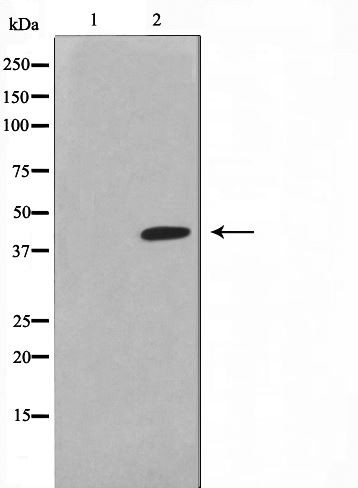
Western blot analysis on HuvEc cell lysate using LASS4 Antibody
This product is for research use only, not for use in diagnostic prodecures or in human.
Hot Tags: rabbit anti-lass4 polyclonal antibody #abs130379, China rabbit anti-lass4 polyclonal antibody #abs130379 suppliers
Send Inquiry
You Might Also Like


