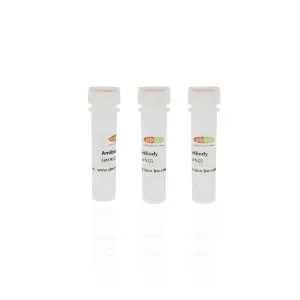
Rabbit Anti-TNFSF11 Polyclonal Antibody #abs130249
Please note that the provided price is for your reference only. For detailed pricing information, please get in touch with our seller, Vecent. To ensure that the generated content is distinct from the original text and not following the conversation format of ChapGPT, I will deliver the message...
Description
Catalog-specification | Delivery time | USD price |
abs130249-50ug | 1-2 Weeks | 201 |
abs130249-100ug | 1-2 Weeks | 301 |
Please note that the provided price is for your reference only. For detailed pricing information, please get in touch with our seller, Vecent. To ensure that the generated content is distinct from the original text and not following the conversation format of ChapGPT, I will deliver the message in a different manner.
Overview | |
Description | TNFSF11 is a cytokine that has the ability to bind to two receptors, TNFRSF11B/OPG and TNFRSF11A/RANK. Its main functions include promoting osteoclast differentiation and activation. Additionally, it enhances the capacity of dendritic cells to stimulate the proliferation of naive T-cells. This cytokine is believed to be a crucial regulator in the interactions between T-cells and dendritic cells, thereby playing a role in the regulation of the T-cell-dependent immune response. Furthermore, it is thought to contribute to increased bone-resorption observed in humoral hypercalcemia of malignancy. |
Other names | The following are different names used to refer to the same protein: CD254, hRANKL2, ODF, OPGL, OPTB2, RANKL, Receptor activator of nuclear factor kappa-B ligand, Osteoclast differentiation factor, Osteoprotegerin ligand, sOdf, TNF related activation induced cytokine, TNF-related activation-induced cytokine, Tumor necrosis factor (ligand) superfamily member 11, Tumor necrosis factor ligand superfamily member 11, Tumor necrosis factor ligand superfamily member 11 soluble form, and TNFSF 11. This protein, also known as TRANCE, plays a crucial role in osteoclast differentiation and bone resorption. Its involvement in diseases such as osteoporosis, rheumatoid arthritis, and cancer has made it a target for therapeutic interventions. Despite having different names, the varied nomenclature does not affect the role and functions of this protein. |
Source | Rabbit |
Specificity | Endogenous levels of total TNFSF11 can be accurately measured using the TNFSF11 antibody. |
Species Reactivity | Human;Mouse |
Predictive reaction species | Pig;Sheep;Dog;Bovine;Horse |
Application | The recommended dilutions for using this antibody are WB 1:500-1:3000, IHC 1:50-1:200, IF 1:200, and ELISA (peptide) 1:20000-1:40000. It is important to follow these dilutions as they have been optimized for best results. For western blotting, a range of dilutions can be used depending on the strength of the signal desired. In immunohistochemistry, dilutions of 1:50-1:200 are optimal for staining tissue sections. For immunofluorescence, a dilution of 1:200 works well. In ELISA, a range of dilutions between 1:20000-1:40000 are effective for detecting peptide antigens. It is important to note that these dilutions may need to be adjusted depending on the specific application and experimental conditions. Overall, this antibody is a valuable tool for investigating protein expression and localization in a variety of research settings. |
Immunogen | A synthesized peptide derived from human TNFSF11. |
Properties | |
Concentration | 1mg/ml |
Purification | Purification of the antiserum was accomplished through the use of SulfoLink™ Coupling Resin for peptide affinity chromatography. The resin played a crucial role in isolating the desired elements of the antiserum through a comprehensive purification process. This advanced technique allowed for the removal of unwanted impurities and ensured that the final product was of the highest possible quality. Thanks to the unique properties of the SulfoLink™ Coupling Resin, the antiserum was effectively purified to meet all required specifications. |
Clonality | Polyclonal Antibody |
Stability & Storage | To maintain the quality of the product, it is recommended to keep it at a temperature of -20 °C for a period of one year. It is important to avoid subjecting it to repeated freeze/thaw cycles. |
Storage buffer | This product is composed of rabbit IgG in a solution of phosphate buffered saline at pH 7.4, along with 150mM of NaCl, 0.02% sodium azide, and 50% glycerol. For optimal stability, it is recommended to store at a temperature of -20 °C. This product is expected to remain stable for up to 12 months from the date of receipt. |
Target | |
Background | Cytokine that binds to TNFRSF11B/OPG and to TNFRSF11A/RANK. Osteoclast differentiation and activation factor. Augments the ability of dendritic cells to stimulate naive T-cell proliferation. May be an important regulator of interactions between T-cells and dendritic cells and may play a role in the regulation of the T-cell-dependent immune response. May also play an important role in enhanced bone-resorption in humoral hypercalcemia of malignancy (PubMed:22664871). Induces osteoclastogenesis by activating multiple signaling pathways in osteoclast precursor cells, chief among which is induction of long lasting oscillations in the intracellular concentration of Ca (2+) resulting in the activation of NFATC1, which translocates to the nucleus and induces osteoclast-specific gene transcription to allow differentiation of osteoclasts. During osteoclast differentiation, in a TMEM64 and ATP2A2-dependent manner induces activation of CREB1 and mitochondrial ROS generation necessary for proper osteoclast generation (By similarity). |
Tissue specificity | Highest in the peripheral lymph nodes, weak in spleen, peripheral blood Leukocytes, bone marrow, heart, placenta, skeletal muscle, stomach and thyroid. |
Posttranslational modification | The soluble form of isoform 1 derives from the membrane form by proteolytic processing (By similarity). The cleavage may be catalyzed by ADAM17. |
Celluar localization | Extracellular region or secreted;Plasma Membrane; |
UniPort | O14788 |
Data Examples

Western blot analysis on HuvEc cell lysate using TNFSF11 Antibody
This product is for research use only, not for use in diagnostic prodecures or in human.
Hot Tags: rabbit anti-tnfsf11 polyclonal antibody #abs130249, China rabbit anti-tnfsf11 polyclonal antibody #abs130249 suppliers
Send Inquiry
You Might Also Like