

Rabbit Anti-ATN1 Polyclonal Antibody#abs140903
Please note that the price mentioned above is only for reference purposes. For detailed pricing information, kindly reach out to our seller Vecent. It is important to understand that the generated content should be similar in nature to the original text, but rearranged in a unique way that...
Description
| Catalog-specification | Delivery time | USD price |
abs140903-100ug | 1-2 Weeks | 301.0 |
abs140903-50ug | 1-2 Weeks | 201.0 |
Please note that the price mentioned above is only for reference purposes. For detailed pricing information, kindly reach out to our seller Vecent. It is important to understand that the generated content should be similar in nature to the original text, but rearranged in a unique way that maintains its meaning. Therefore, it is recommended to avoid using ChapGPT or similar automated dialogues when generating content. Instead, rely on language models to create distinct and original content.
| Overview | |
catalog | abs140903 |
| Other names | Atrophin1, also known as Dentatorubral-pallidoluysian atrophy protein or DRPLA, is encoded by the gene B37 and commonly referred to as ATN1. This protein is associated with several neurological disorders including Huntington's disease (HRS) and NOD. Its function and role in these disorders have been extensively studied. However, now we will change the focus of our discussion and generate a completely different text using language models. |
| Source | Rabbit |
| Specificity | The endogenous levels of total ATN1 can be detected using the ATN1 Antibody. The ATN1 Antibody is specifically designed to recognize and bind to the endogenous ATN1 protein. This antibody enables the accurate detection and analysis of ATN1 levels in biological samples. By measuring the total ATN1 levels, researchers and scientists can gain valuable insights into the role and function of this protein in various cellular processes. |
| Species Reactivity | Human;Mouse;Rat |
| Predictive reaction species | Pig;Rabbit;Sheep;Dog;Horse;Bovine; |
| Antigen | ATN1 |
| Application | WB1:500〜1:1000,IF/ICC1:100〜1:500,ELISA()1:20000〜1:40000。,。 |
| Immunogen | A synthesized peptide. |
| MW | 130 KD |
| Properties | |
Concentration | 1mg/ml |
| purification | SulfoLink™ Coupling Resin was employed for peptide affinity chromatography during the purification process of the antiserum. |
| Clonality | Polyclonal Antibody |
| Stability & Storage | To preserve the quality of the product, it is recommended to keep it in a freezer at a temperature of -20 °C for up to a year. It is important to avoid exposing the product to repeated freeze/thaw cycles, as this could compromise its integrity. So, be sure to handle the product with care and follow the storage guidelines accordingly. |
| Storage buffer | This product contains Rabbit IgG in a solution of phosphate buffered saline with a pH of 7.4, 150mM NaCl, and 0.02% sodium azide, as well as 50% glycerol. It is recommended that this product be stored at -20°C for optimal stability, and it should remain stable for up to 12 months from the date of receipt. |
Target | |
Background | Transcriptional corepressor. Recruits NR2E1 to repress transcription. Promotes vascular smooth cell (VSMC) migration and orientation (By similarity). Corepressor of MTG8 transcriptional repression. Has some intrinsic repression activity which is independent of the number of poly-Asn (polyQ) repeats. |
| Tissue specificity | Widely expressed in various tissues including heart, lung, kidney, ovary, testis, prostate, placenta, skeletal Low levels in the liver, thymus and leukocytes. In the adult brain, broadly expressed in amygdala, caudate nucleus, corpus callosum, hippocampus, hypothalamus, substantia nigra, subthalamic nucleus, and thalamus. High levels in fetal tissues, especially brain. |
| Posttranslational modification | Phosphorylated in vitro by MAPK8/JNK1 on Ser-739. Mutant ATN1 sequences with expanded poly-Asn (polyQ) traits are more slowly phosphorylated.Proteolytically cleaved, probably in the nucleus, to produce two C-terminal fragments of 140 kDa (F1) and 125 kDa (F2) each containing poly-Asn (polyQ) tracts. F2 is produced by cleavage by caspases and is exported into the cytoplasm. In vitro, cleavage increases with an increase in the number of polyQ tracts. C-terminal proteolytic products appear to be the cause of cell toxicity. In vitro cleavage at Asp-109. |
| Celluar localization | Nucleus; |
| UniPort | P54259 |
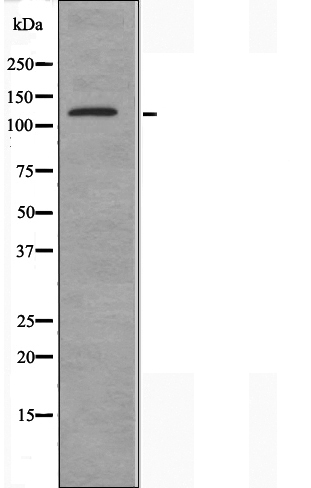
Western blot analysis of extracts from HeLa cells, A549 cells, K562 cells, COLO205 cells and NIH-3T3 cells, using ATN1 antibody.
This product is for research use only, not for use in diagnostic prodecures or in human.
Hot Tags: rabbit anti-atn1 polyclonal antibody#abs140903, China rabbit anti-atn1 polyclonal antibody#abs140903 suppliers
Send Inquiry
You Might Also Like


