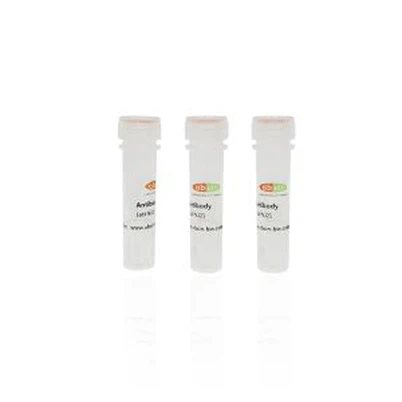
Phospho-CD227/MUC1(Tyr1229) Rabbit Polyclonal Antibody #abs130012
Please note that the price mentioned above is for your reference only. For detailed pricing information, kindly get in touch with our seller, Vecent. For an alternative approach to generating content, it is advised to avoid relying on the way ChapGPT generates text and instead utilize a language...
Description
Catalog-specification | Delivery time | USD price |
abs130012-50ug | 1-2 Weeks | 201 |
abs130012-100ug | 1-2 Weeks | 301 |
Please note that the price mentioned above is for your reference only. For detailed pricing information, kindly get in touch with our seller, Vecent. For an alternative approach to generating content, it is advised to avoid relying on the way ChapGPT generates text and instead utilize a language model to produce significantly different speech patterns.
Overview | |
Description | This is a mucin gene belonging to the group of membrane-bound, glycosylated phosphoproteins. The protein is anchored to the apical surface of multiple epithelia through a transmembrane domain, with glycosylation varying depending on the cell type. It has a protective function, binding to pathogens and serving as a cell signaling molecule. The protein has been linked to carcinomas, with overexpression, aberrant intracellular localization, and changes in glycosylation all playing a role. Different isoforms have also been identified through alternate transcriptional splice variants. |
Other names | The following terms are all related to the protein Mucin 1 (MUC1), which is involved in various types of cancer. Some of these terms refer to specific forms of MUC1, such as the alpha and beta subunits, while others are associated with specific types of cancer or other conditions. |
Source | Rabbit |
Specificity | The Phospho-CD227/MUC1(Tyr1229) Antibody is able to identify CD227 and MUC1 proteins that are only phosphorylated at Tyrosine 1229 and found at their natural levels. |
Species Reactivity | Human |
Application | The recommended dilution ratio for WB is between 1:500-1:2000, for IHC it is 1:50-1:200, for IF/ICC it is 1:100-1:500, and for ELISA(peptide) it is 1:20000-1:40000. It is important to follow these guidelines in order to achieve accurate and consistent results in your experiments. Dilution ratios outside of these ranges may lead to non-specific binding and inaccurate data. Always be sure to carefully prepare and dilute your samples according to the instructions provided. |
Immunogen | A highly similar content can be generated by stating that a peptide has been synthesized from human CD227/MUC1, which has been derived from the phosphorylation site of Tyrosine 1229. The peptide is designed to mimic the natural protein and is capable of exerting similar effects in vivo. This process involves extensive research and testing to ensure the peptide's safety and efficacy, thus making it suitable for use in various therapeutic applications. The synthesized peptide is expected to enhance our understanding of CD227/MUC1 and could lead to the development of novel treatments for various diseases. |
Properties | |
Concentration | 1mg/ml |
Purification | The antibody is from purified rabbit serum by affinity purification via sequential chromatography on phospho- and non-phospho-peptide affinity columns. |
Clonality | Polyclonal Antibody |
Stability & Storage | Store at -20 °C for one year. Avoid repeated freeze/thaw cycles |
Storage buffer | Rabbit IgG in phosphate buffered saline , pH 7.4, 150mM NaCl, 0.02% sodium azide and 50% glycerol.Store at -20 °C.Stable for 12 months from date of receipt. |
Target | |
Background | The alpha subunit has cell adhesive properties. Can act both as an adhesion and an anti-adhesion protein. May provide a protective layer on epithelial cells against bacterial and enzyme attack. |
Tissue specificity | Expressed on the apical surface of epithelial cells, especially of airway passages, breast and uterus. Also expressed in activated and unactivated T-cells. Overexpressed in epithelial tumors, such as breast or ovarian cancer and also in non-epithelial tumor cells. Isoform Y is expressed in tumor cells only. |
Posttranslational modification | Highly glycosylated (N- and O-linked carbohydrates and sialic acid). O-glycosylated to a varying degree on serine and threonine residues within each tandem repeat, ranging from mono- to penta-glycosylation. The average density ranges from about 50% in human milk to over 90% in T47D breast cancer cells. Further sialylation occurs during recycling. Membrane-shed glycoproteins from kidney and breast cancer cells have preferentially sialyated core 1 structures, while secreted forms from the same tissues display mainly core 2 structures. The O-glycosylated content is overlapping in both these tissues with terminal fucose and galactose, 2- and 3-linked galactose, 3- and 3,6-linked GalNAc-ol and 4-linked GlcNAc predominating. Differentially O-glycosylated in breast carcinomas with 3,4-linked GlcNAc. N-glycosylation consists of high-mannose, acidic complex-type and hybrid glycans in the secreted form MUC1/SEC, and neutral complex-type in the transmembrane form, MUC1/TM.Proteolytic cleavage in the SEA domain occurs in the endoplasmic reticulum by an autoproteolytic mechanism and requires the full-length SEA domain as well as requiring a Ser, Thr or Cys residue at the P + 1 site. Cleavage at this site also occurs on isoform MUC1/X but not on isoform MUC1/Y. Ectodomain shedding is mediated by ADAM17.Dual palmitoylation on cysteine residues in the CQC motif is required for recycling from endosomes back to the plasma membrane.Phosphorylated on tyrosines and serine residues in the C-terminal. Phosphorylation on tyrosines in the C-terminal increases the nuclear location of MUC1 and beta-catenin. Phosphorylation by PKC delta induces binding of MUC1 to beta-catenin/CTNNB1 and thus decreases the formation of the beta-catenin/E-cadherin complex. Src-mediated phosphorylation inhibits interaction with GSK3B. Src- and EGFR-mediated phosphorylation on Tyr-1229 increases binding to beta-catenin/CTNNB1. GSK3B-mediated phosphorylation on Ser-1227 decreases this interaction but restores the formation of the beta-cadherin/E-cadherin complex. On T-cell receptor activation, phosphorylated by LCK. PDGFR-mediated phosphorylation increases nuclear colocalization of MUC1CT and CTNNB1.The N-terminal sequence has been shown to begin at position 24 or 28. |
Celluar localization | Extracellular region or secreted;Golgi apparatus;Nucleus;Plasma Membrane; |
UniPort | P15941 |
Data Examples

Western blot analysis on HepG2 cell lysate using Phospho-CD227/MUC1(Tyr1229) Antibody
This product is for research use only, not for use in diagnostic prodecures or in human.
Hot Tags: phospho-cd227/muc1(tyr1229) rabbit polyclonal antibody #abs130012, China phospho-cd227/muc1(tyr1229) rabbit polyclonal antibody #abs130012 suppliers
Send Inquiry
You Might Also Like