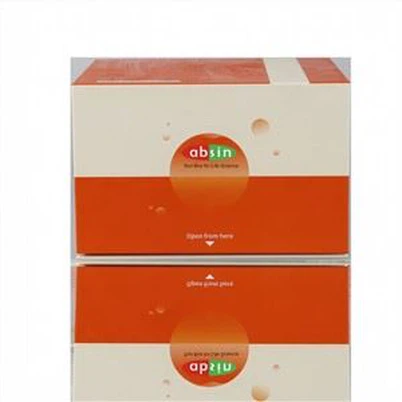
Mouse TGF-beta 1 ELISA Kit
Please note that the price provided is for reference purposes only. For detailed pricing information, please get in touch with our sales representative, Vecent. We highly recommend reaching out to Vecent for accurate pricing details. Testing Principle The sandwich enzyme immunoassay utilized in...
Description
| SKU-Pack Size | Availability | Price |
| abs520021-96T | In stock | $450.00 |
Please note that the price provided is for reference purposes only. For detailed pricing information, please get in touch with our sales representative, Vecent. We highly recommend reaching out to Vecent for accurate pricing details.
Testing Principle
The sandwich enzyme immunoassay utilized in this kit involves several steps. Firstly, microplates are coated with Anti-mouse TGF-Beta 1 monoclonal antibody. When the sample and standard containing TGF-Beta 1 are added, they bind to the fixed antibodies on the plate, while the unbound components are washed away.
Next, Biotin-labeled anti-mouse TGF-Beta 1 polyclonal antibody is introduced, which specifically binds to TGF-Beta 1 on the microplate. Once again, the free components are washed away.
In the subsequent step, streptavidin-labeled horseradish peroxidase is added to the microplate, forming a complex with the biotin labeled antibody. This complex is highly specific as streptavidin recognizes biotin. After washing away the unbound components, a substrate solution (chromogener) is added, leading to a gradual color change to blue.
To stop the color development, a stop solution is added, resulting in a yellow solution that no longer undergoes any color change. Ultimately, this process allows for the measurement of TGF-Beta 1 levels in the sample through the detection of the color signal.
Detection type:sandwich enzyme immunoassay
Form: pre-coated 96-well plate
Sample type: Cell culture supernatant, Serum, Plasma
Note:To detect TGFβ1, it is necessary to undergo a sample activation treatment prior to testing. The details of this operation can be found in the instruction manual. Please ensure that you follow the instructions carefully in order to achieve accurate and reliable results.
Sample quantity: 100ul
Kit composition:
In order to conduct a TGF-β1 ELISA assay, we will need a 96 well polystyrene microplate that has been coated with the capture antibody. We will also need a standard for comparison, as well as Anti-mouse TGF-β1 detection antibody and a dilution buffer for this purpose. The assay will require color reagents A and B, in addition to sample activation fluid and scrubbing solution.
To stop the reaction, we will need stop buffer and SA-HRP. Finally, we will seal the plate with a membrane and refer to a specification for procedural guidance. This setup will enable us to quantitate levels of TGF-β1 in a given biological sample..
Sensitivity:6.8 pg/mL
Detection range:31.2 - 2,000 pg/mL
Recovery rate:87.0-113.2%
Storage:2-8℃
The standard curve

Background:
TGF Beta 1, 2, and 3, also known as transforming growth factors, are versatile cytokines that can be secreted by nearly all cell types. These molecules have been suggested to act as cellular switches, regulating immune function, proliferation, and the transformation of epithelial cells into mesenchymal cells. Through targeted gene deletion experiments in mice, it has been revealed that each subtype of TGF-beta plays distinct roles: TGF Beta 1 is involved in the development of blood cells and endothelial cells; TGF Beta 2 influences the development of various organs such as the heart, lungs, craniofacial structures, limbs, eyes, ears, and the genitourinary system; TGF Beta 3 impacts the development of the palate and lungs. As for TGF Beta 5, its full range of biological activities in vitro remains largely unknown. However, in inhibitory bioassays, TGF Beta 1, 2, 3, and 5 have been found to exhibit similar effects, suggesting that TGF Beta 5 likely shares similarities with other members of the TGF Beta family. Currently, the production of TGF Beta 5 has only been observed in Xenopus.
TGF-beta ligand is initially synthesized as a precursor protein that undergoes proteolytic cleavage. The mature segment forms an active ligand dimer with a characteristic "cysteine junction" consisting of disulfide bonded nuclei. TGF- Beta signal transduction begins with binding to a complex of accessory receptor beta-glycan (known as TGF- Beta RIII) and type II serine/threonine kinase receptors (known as TGF- Beta RII). The receptor then phosphorylates and activates the receptor for type I serine/threonine kinase, known as ALK-1 or TGF- Beta RI (known as ALK-5). The activated type I receptor phosphorylates and activates the Smad protein that regulates transcription. Different responses to TGF-beta can be observed under different conditions using other signaling pathways independent of Smad.
Hot Tags: mouse tgf-beta 1 elisa kit, China mouse tgf-beta 1 elisa kit suppliers
Send Inquiry
You Might Also Like