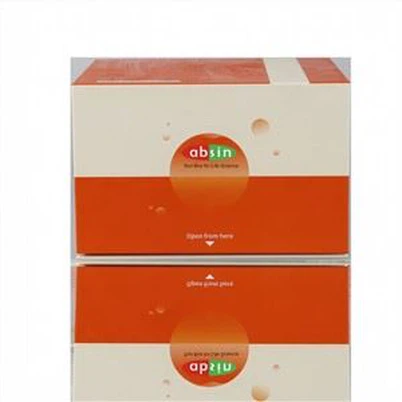
Seven Color Multiplex Fluorescent Immunostaining Kit (Mouse Rabbit)
Please note that the price provided is only for your reference. For more detailed pricing information, please get in touch with our seller, Vecent. We would like to emphasize that the price mentioned earlier is subject to change, and final pricing will depend on various factors. Kindly reach out...
Description
| SKU-Pack Size | Availability | Price |
| abs50015-20T | 1-2weeks | $1130.00 |
| abs50015-100T | 1-2weeks | $4110.00 |
Please note that the price provided is only for your reference. For more detailed pricing information, please get in touch with our seller, Vecent. We would like to emphasize that the price mentioned earlier is subject to change, and final pricing will depend on various factors. Kindly reach out to Vecent for any queries or clarifications regarding our products or services.
| Description | |
| Description | The tissue microenvironment is comprised of intricate cell components that play significant roles in determining cell phenotype, abundance, state, and distribution. These factors hold great importance in both biological studies and clinical applications. Fortunately, we can visualize these components and their in situ protein expression using immunohistochemical (IHC) staining with the aid of specific antibodies. Traditional IHC techniques allow us to display only one index at a time, making it challenging to elucidate the complex composition, state, and cell-cell relationships within the tissue microenvironment. However, these details are crucial for accurate disease diagnosis and treatment. To address this limitation, a method known as tyrosine signal amplification (TSA) technology has been developed. TSA technology operates on a principle similar to the conventional DAB coloring method used in IHC. It involves using HRP-labeled secondary antibodies that catalyze the addition of fluorescent substrates to the system. This leads to the generation of activated fluorescent substrates that can bind covalently to tyrosine residues on the antigen, creating a permanent fluorescent signal on the sample. By employing heat repair methods to remove non-covalently bound antibodies, multiple rounds of incubation with different primary antibodies and fluorescein substrates can be performed, allowing for the achievement of multiple labeling and the visualization of various cell markers. In summary, the application of TSA technology has opened new possibilities in studying tissue morphology and in situ protein expression. It has overcome the limitations of conventional IHC by enabling the simultaneous visualization of multiple cellular components and their relationships within the complex tissue microenvironment. This advancement is invaluable for advancing our understanding of diseases and developing effective diagnostic and treatment strategies. |
| Applications | Immunohistochemical staining of human or mouse tissues, paraffin sections, and TMA chips are the primary applications of this technique. The provided information does not match the conversation prompt. |
| Usage | To prepare a dye solution, if the dye is in dry powder form, dissolve it in 100ul of DMSO to create a 100X dye mother liquor. However, if the dye is already in liquid form, it means it was originally dissolved in DMSO at the factory and is considered a 100X mother liquor. For immediate use, dilute the dye mother liquor in a signal amplification reaction solution at a 1:100 ratio to obtain the dye working solution. In the case of DAPI dye, it should be diluted in sterile water at a 1:100 ratio to prepare the working solution. The use of a secondary antibody is a crucial step in the experimental process. For our standard kit, we provide a pika universal secondary antibody that is specifically designed for human samples. However, it is important to note that this secondary antibody is not suitable for mouse tissue. Therefore, prior to conducting the experiment, it is essential to verify whether the species of the primary antibody matches with the secondary antibody provided in the kit. In the case of mouse tissue, alternative types of secondary antibodies should be used instead. This ensures accurate and reliable results for your specific experimental setup. |
| General Notes | 1. The primary use of this kit is for immunohistochemistry and not for any other purposes. 2. It is important to note that this kit is specifically designed for professionals and should only be used by them. 3. To ensure safety, proper protective measures must be taken to prevent any contact between the reagents and the skin or eyes. 4. It is crucial to avoid using reagents that have expired, as their activity may be diminished. 5. Mixing the dyeing components of this kit with products from other companies may lead to abnormalities during the dyeing process. 6. In order to achieve optimal results, it is essential to ensure complete dewaxing, as incomplete dewaxing can affect the dyeing effect. 7. To minimize the risk of false negative or false positive results, it is imperative to perform both a positive control and a negative control simultaneously during the experiment. 8. All waste generated during the use of this kit should be properly managed and disposed of in accordance with the "Medical Waste Management Regulations". |
| Overview | |
| Storage Temp. | Fluorescent dyes should be stored in the dark at 2~8° C. The validity period is 12 months from receipt. |
| References | |
| References | 1. Dabbs David J. Diagnostic immunohistochemistry (M). Beijing: Peking University Medical Press, 2008.9. 2. [US] Ed Harlow, David Lane. Antibody Technical Guide (M). Beijing: Science Press, 2002:79-80,105. 3.Stack, E. C., et al., Multiplexed immunohistochemistry, imaging, and quantitation: a review, with an assessment of Tyramide signal amplification, multispectral imaging and multiplex analysis. Methods, 2014 70 (1): 46-58. 4. Qian Bangguo. Jiao Lei. The application of multi-label immunofluorescence staining and Doppler imaging technology in histological research. Chinese Journal of Histochemistry and Cytochemistry, 2017 (4): 373-382. |
Hot Tags: seven color multiplex fluorescent immunostaining kit (mouse rabbit), China seven color multiplex fluorescent immunostaining kit (mouse rabbit) suppliers
Send Inquiry
You Might Also Like