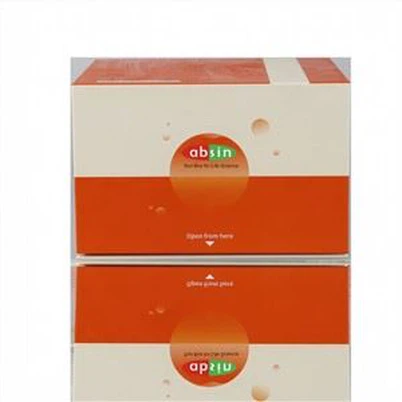
Cell Proliferation Assay Kit(MTS)
Please note that the price provided is only for your reference and may not be accurate. For detailed pricing information, we recommend that you get in touch with our seller Vecent. It's essential to get in touch with our seller to get an accurate understanding of the price for the product or...
Description
| SKU-Pack Size | Availability | Price |
| abs50011-200T | 1-2weeks | $85.00 |
| abs50011-1000T | 1-2weeks | $340.00 |
Please note that the price provided is only for your reference and may not be accurate. For detailed pricing information, we recommend that you get in touch with our seller Vecent. It's essential to get in touch with our seller to get an accurate understanding of the price for the product or service you are interested in. Our seller can provide you with all the details you need to make an informed decision. So, don't hesitate to contact Vecent for more information.
| Description | |
| Description | The Cell Proliferation Assay (MTS) is a reliable method for analyzing cell proliferation, cytotoxicity, and chemical sensitivity. It utilizes a colorimetric approach to determine the number of viable cells present. The assay reagent consists of MTS, a tetrazolium compound (3-(4,5-dimethylthiazol-2-yl)-5-(3-carboxymethoxyphenyl)-2-(4-sulfophenyl)-2H-tetrazolium, internal salt), and PES, an Electron coupling reagent (ethylthiophenazine). PES offers enhanced stability compared to PMS and can be combined with MTS to form a stable solution. To conduct the assay, a small amount of the reagent is added directly to the culture well and incubated for 1-4 hours. The absorbance at 490nm is then measured using a 96-well plate reader, with the intensity of the formazan product directly correlating with the number of viable cells in the culture. |
| Usage | To completely thaw the 20ml size, you can either leave the Reagent at room temperature for approximately 90 minutes or place it in a water bath at 37°C for about 10 minutes. Add 20µl of Reagent to each well of the 96-well assay plate. The plate already contains the samples, which are in 100µl of culture medium. For ease of use and accuracy, we suggest using a repeating pipette, digital pipette, or multichannel pipette to dispense the Reagent into the 96-well plate. This will ensure consistent volumes are delivered to each well and streamline your workflow. To initiate growth, place the plate in a 5% CO2 environment with high humidity and incubate it at 37°C for a period of 1 to 4 hours. Please ensure that you proceed promptly to measure the quantity of formazan that is soluble, resulting from the reduction of MTS by cells. It is crucial to generate content that closely resembles the original information and refrain from using the dialogue-based content generation approach. Instead, employ a language model to deliver speech in a completely different manner. For Step 4, there are two options for measuring absorbance. The first option is to measure absorbance immediately by using a plate reader. To do this, add 25µl of 10% SDS to each well and then measure the absorbance. The second option is to measure absorbance later. To do this, add 25µl of 10% SDS to each well to stop the reaction and then store the plate until later analysis. Both options provide accurate measurements of the reaction’s absorbance, so choose the method that suits your needs the best. To preserve the SDS-treated plates, it's vital to store them in a moisture-controlled environment at room temperature. Keep them away from light for a maximum of 18 hours before proceeding to the next step. To measure the absorbance at 490nm, utilize a 96-well plate reader. Take note of the recorded data and ensure it remains accurate and consistent with the original measurements. |
| Overview | |
| Storage Temp. | Store at 2~8° C away from light. |
| Properties | |
| Synonym | Cell Proliferation Assay Kit(MTS) |
Hot Tags: cell proliferation assay kit(mts), China cell proliferation assay kit(mts) suppliers
Send Inquiry
You Might Also Like