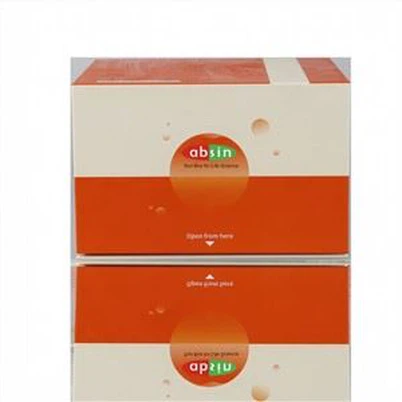
Annexin V-APC/PI Apoptosis Detection Kit
Please note that the price mentioned is for reference purposes only. If you require the detailed pricing information, kindly get in touch with our sales representative, Vecent. We request you to understand that the actual pricing may vary based on different factors, and hence it is important to...
Description
| SKU-Pack Size | Availability | Price |
| abs50009-25T | stockout | $300.00 |
| abs50009-100T | stockout | $720.00 |
Please note that the price mentioned is for reference purposes only. If you require the detailed pricing information, kindly get in touch with our sales representative, Vecent. We request you to understand that the actual pricing may vary based on different factors, and hence it is important to confirm the same with our representative.
| Description | |
| Description | Annexin V, also known as Annexin A5, is a protein belonging to the annexin family of intracellular proteins. Its main function is to bind to phosphatidylserine (PS) in a calcium-dependent manner. In healthy cells, PS is typically present exclusively on the inner leaflet of the plasma membrane. However, during the early stages of apoptosis, the normal membrane asymmetry is disrupted and PS relocates to the outer leaflet. By utilizing Annexin V labeled with a fluorescent dye, one can selectively target and identify apoptotic cells. To achieve optimal results, it is recommended to use Annexin V Binding Buffer along with Annexin V staining. The following products are available for this purpose: Annexin V-APC, Propidium Iodide solution, Annexin V Binding Buffer, and Apoptosis Positive Control Solution. |
| Applications | To ensure the quality of each batch, the reagent undergoes rigorous quality control testing. This involves immunofluorescent staining followed by flow cytometric analysis. The recommended usage of the reagent is 5 µl for every 10^5 cells. However, since the applications can vary, it is necessary to determine the appropriate dilutions for specific uses. |
| Usage | Suggested Staining Protocol A.Parameters regulation 1. Harvest cell(1×10⁶ -3×10⁶Take a culture of cells, preferably adherent cells. Gently detach the cells from the surface using a suitable cell detachment method. Be careful not to cause excessive cell damage during this step. Once detached, transfer the cells to a sterile centrifuge tube. To ensure the cells are evenly distributed, it is advisable to perform this step slowly and carefully. Once all the cells are in the centrifuge tube, carefully add cold PBS (phosphate-buffered saline) to the tube, making sure to cover the cells completely. The cold temperature helps to prevent cell clumping and maintains cell viability. Gently mix the cells with the PBS to ensure thorough washing. Next, centrifuge the tube containing the cells and PBS mixture. The centrifugation force should be set appropriately, depending on the cell type and the specific experimental requirements. After centrifugation, the cells will settle at the bottom of the tube, forming a pellet, while the supernatant containing unwanted debris will be present above the cell pellet. Carefully discard the supernatant without disturbing the cell pellet. It's crucial to remove all the supernatant to avoid contaminating the cells with unwanted substances. Once the supernatant is removed, the cells are ready for the next step in the experimental procedure. Remember to follow good laboratory practices and maintain sterility throughout the process to ensure the reliability and validity of your experimental results. Store the suspended part of cells in 200μL 1× binding buffer at 4°C for use. Firstly, suspend the rest of the cells in 500μL of Apoptosis Positive Control Solution and let them incubate at room temperature for 10 minutes. Next, wash the cells using over 3.0 mL of cold PBS, removing any excess liquid. Then, gently resuspend the cells in 200μL of 1× binding buffer. First, combine the two parts of cells together and then distribute them into three tubes. Next, add 100 μL of cells into each tube. In the first tube, we have a Blank Control. Moving on to the second tube, we add 5 μL of Annexin V-APC. Lastly, in the third tube, we add 5 μL of PI solution. After adding the necessary reagents to each tube, it is recommended to gently vortex them and leave them to incubate for 5 minutes at room temperature. While they are incubating, it is essential to ensure that they are protected from light to prevent any potential interference. In order to effectively analyze samples by flow cytometry, it is essential to properly regulate voltage and compensation. The recommended approach involves utilizing a blank control and single dye sample to achieve optimal settings, as illustrated in Figure Parameters regulation. This protocol ensures that accurate and reliable data will be obtained, enabling successful analysis of cellular characteristics. Taking the necessary measures to regulate parameters is critical to achieving high-quality results and advancing scientific understanding. B.Sample detection For 10 tests, you need to dilute 3 mL of 10x binding buffer with 27 mL of distilled water. This will give you the necessary volume of binding buffer for your experiments. It's important to be precise with your measurements to ensure accurate results. So, take your time and follow the instructions carefully. Good luck with your experiments! 2. Harvest cell(about 1×10⁶cells per test)then wash with cold PBS. To begin, place the cells in 1 mL of 1× Binding Buffer. Next, centrifuge the cells at 300×g for a duration of 10 minutes. Once the centrifugation is complete, carefully remove the Binding Buffer from the cell pellet. To begin the protocol, the cells should be resuspended in 1 mL of 1× Binding Buffer. It is important to adjust the cell concentration to 1×10. This step is crucial to prepare the cells for the subsequent procedures.66cells/mL. 5. Add 100 μL of cells (1×10⁵cells) to each labeled tube. 6. Add 5 μL of Annexin V-APC to appropriate tubes. 7. Gently vortex each tube and incubate for 10 minutes in room temperature, protected from light. 8. Add 5 μL PI solution incubation for 5min in room temperature, protected from light. 9. Add PBS to 500μL and vortex gently. 10. Analyze by flow cytometry in 1 hour. |
| Storage Temp. | Keep as concentrated solution. Store at 4°C and protected from prolonged exposure to light. Do not freeze.The validity period is 6 months. |
Hot Tags: annexin v-apc/pi apoptosis detection kit, China annexin v-apc/pi apoptosis detection kit suppliers
Send Inquiry
You Might Also Like