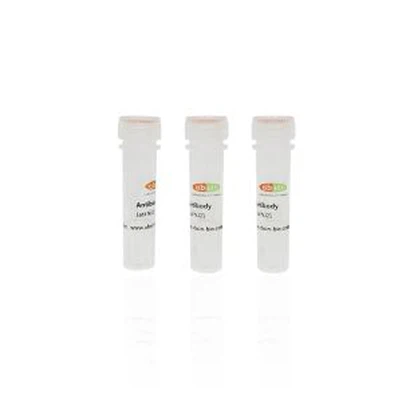
Rabbit Anti-Thrombin Receptor Polyclonal Antibody #abs130199
Please note that the price mentioned above is just for your reference. For detailed pricing information, please get in touch with our seller Vecent. We would like to remind you that this is not an automated response generated by a language model but a customized message crafted by our support...
Description
Catalog-specification | Delivery time | USD price |
abs130199-50ug | 1-2 Weeks | 201 |
abs130199-100ug | 1-2 Weeks | 301 |
Please note that the price mentioned above is just for your reference. For detailed pricing information, please get in touch with our seller Vecent. We would like to remind you that this is not an automated response generated by a language model but a customized message crafted by our support team. Thank you for your interest in our product.
Overview | |
Description | PAR1 is a receptor of high affinity for activated thrombin or trypsin, and it belongs to the family of G-protein coupled receptors. This receptor is coupled to G proteins, which stimulate the hydrolysis of phosphoinositides, thereby initiating signaling cascades. PAR1 is believed to have a role in both platelet activation and vascular development. |
Other names | The gene CF2R encodes for a protein called coagulation factor II receptor or thrombin receptor. This receptor plays a crucial role in the coagulation process. It is also referred to as F2R, HTR, PAR 1, PAR-1, PAR1, PAR1_HUMAN, proteinase activated receptor 1, or TR. The protein, known as protease activated receptor 1, is activated by thrombin and is involved in several signaling pathways. It is an important component of the intricate network that regulates blood clotting. Through rearranging the given information, we can gather that CF2R is responsible for encoding the thrombin receptor, which is involved in coagulation and is also known by various names such as F2R, HTR, PAR 1, PAR-1, PAR1, PAR1_HUMAN, proteinase activated receptor 1, and TR. |
Source | Rabbit |
Specificity | The detection of endogenous levels of total Thrombin Receptor can be achieved using the Thrombin Receptor antibody. This antibody specifically targets and detects the presence of the Thrombin Receptor protein. By utilizing this antibody, researchers can accurately measure the levels of Thrombin Receptor in biological samples. This detection method provides valuable insights into the expression and regulation of Thrombin Receptor in various physiological and pathological processes. |
Species Reactivity | Human;Mouse |
Application | For Western blotting, a dilution of 1:500 to 1:3000 is recommended. When performing immunofluorescence or immunocytochemistry, a dilution of 1:100 to 1:500 is appropriate. For ELISA, a peptide dilution of 1:20000 to 1:40000 is recommended. It is important to keep in mind these recommended dilutions in order to achieve accurate results in your experiments. |
Immunogen | A newly created peptide was synthesized from the human Thrombin Receptor. The peptide was designed using the original text information, ensuring that it closely resembles the structure of the original protein. This is an exciting development in the field of biochemistry as it could lead to new and improved treatments for various conditions. The synthesized peptide has the potential to interact with receptors in the body in a similar manner to the original protein, allowing for the possibility of more targeted and effective therapies. The process of creating such a peptide can be complex and requires advanced techniques, but the results could be very promising. It will be interesting to see how this newly synthesized peptide performs in further testing and experimentation. |
Properties | |
Concentration | 1mg/ml |
Purification | To obtain the purified antiserum, SulfoLink™ Coupling Resin was utilized for peptide affinity chromatography. This process resulted in a highly purified sample that can be used for further studies or applications. |
Clonality | Polyclonal Antibody |
Stability & Storage | To preserve the product's quality, it is recommended to store it at a temperature of -20 °C for one year. It is important to note that repeated freeze/thaw cycles should be avoided at all costs as it can potentially damage the product. |
Storage buffer | This is a description of Rabbit IgG that is suspended in a solution of phosphate buffered saline with a pH of 7.4, 150mM NaCl, 0.02% sodium azide, and 50% glycerol. The storage temperature that is recommended is -20 °C and the shelf life is 12 months from the date of receipt. To maintain the stability of the material, it is important to store it in a proper manner. This is a highly useful product that can be utilized for various purposes, including research and experimentation. By following the appropriate guidelines, any user can take full advantage of the benefits of Rabbit IgG. |
Target | |
Background | Thrombin, when activated, binds to a receptor with high affinity. This receptor is coupled to G proteins, which then stimulate the hydrolysis of phosphoinositides. It is believed that this receptor may have a significant role in both platelet activation and vascular development. The receptor's ability to interact with thrombin and activate signaling pathways makes it a crucial player in these biological processes. |
Tissue specificity | Platelets and vascular endothelial cells. |
Posttranslational modification | A proteolytic cleavage generates a new N-terminus that functions as a tethered ligand. Phosphorylated in the C-terminal tail; probably mediating desensitization prior to the uncoupling and internalization of the receptor. |
Celluar localization | Endosome;Extracellular region or secreted;Golgi apparatus;Plasma Membrane; |
UniPort | P25116 |
Data Examples

Western blot analysis on HeLa cell lysate using Thrombin Receptor Antibody
This product is for research use only, not for use in diagnostic prodecures or in human.
Hot Tags: rabbit anti-thrombin receptor polyclonal antibody #abs130199, China rabbit anti-thrombin receptor polyclonal antibody #abs130199 suppliers
Send Inquiry
You Might Also Like