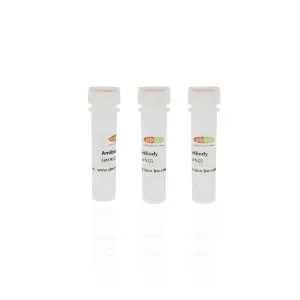
Rabbit Anti-TFIP8 Polyclonal Antibody #abs130323
Please note that the price provided is for reference only. To obtain a detailed price, please get in touch with our sales representative Vecent. It is important to understand that the quoted price may differ from the actual price, therefore, we recommend contacting our sales team to obtain...
Description
Catalog-specification | Delivery time | USD price |
abs130323-50ug | 1-2 Weeks | 201 |
abs130323-100ug | 1-2 Weeks | 301 |
Please note that the price provided is for reference only. To obtain a detailed price, please get in touch with our sales representative Vecent. It is important to understand that the quoted price may differ from the actual price, therefore, we recommend contacting our sales team to obtain accurate pricing information.
Overview | |
Description | TNFAIP8 is an important mediator in the regulation of cell survival, and its role in tumor progression has been identified. This protein is involved in the inhibition of caspase-8 activity, without affecting the processing of procaspase-8, which ultimately suppresses TNF-mediated apoptosis. Furthermore, it inhibits BID cleavage and caspase-3 activation, indicating its anti-apoptotic function. TNFAIP8 belongs to the family of TNFAIP proteins and is induced by nuclear factor-KB (NF-KB) and TNF. Its induction by TNF is dependent on the activation of NF-KB. Therefore, TNFAIP8 plays a crucial role in cell survival and may present a potential therapeutic target in cancer treatment. |
Other names | Protein related to head and neck tumor and metastasis: GG2 1, also known as MDC-3.13, NDED, NF-kappa-B-inducible DED-containing protein, SCC S2, SCC-S2, SCCS2, TFIP8_HUMAN, TNF alpha-induced protein 8, TNF induced protein, TNF-induced protein GG2-1, TNFAIP 8, TNFAIP8, and tumor necrosis factor alpha-induced protein 8. This protein is associated with tumor development and spread in the head and neck region. It is prominently induced by TNF-alpha, a signaling molecule involved in inflammation. GG2 1 plays a crucial role in cellular processes regulated by NF-kappa-B, a transcription factor that controls gene expression. Its presence has been detected in squamous cell carcinoma cell line SCC-S2. With its diverse aliases, GG2 1 is a notable protein of interest in tumor biology and its interactions with the immune system. |
Source | Rabbit |
Specificity | TFIP8 Antibody detects endogenous levels of TFIP8 |
Species Reactivity | Human;Mouse |
Application | For immunohistochemistry, the recommended dilutions are between 1:500 to 1:2000, while 1:50 to 1:200 dilutions are suitable for IF/ICC assays. ELISA with peptide should be diluted at 1:20000 to 1:40000 to ensure accurate results. To provide alternative wording for this information, one could say that the optimal dilutions for WB immunoblotting range from 1:500 to 1:2000, whereas IF/ICC experiments require a dilution of 1:100 to 1:500. For ELISA using a peptide substrate, it is recommended to use a dilution of 1:20000 to 1:40000 in order to obtain precise results. |
Immunogen | A synthesized peptide derived from human TFIP8 |
Properties | |
Concentration | 1mg/ml |
Purification | Immunogen affinity purified |
Clonality | Polyclonal Antibody |
Stability & Storage | To ensure optimal storage conditions, it is recommended to keep the item at a temperature of -20 °C for a period of one year. It is important to avoid subjecting the item to multiple freeze/thaw cycles, which can potentially compromise its quality. Therefore, it is advised to handle the item with care and store it properly to maintain its stability and efficacy. |
Storage buffer | This product is Rabbit IgG dissolved in phosphate buffered saline (pH 7.4) containing 150mM NaCl and 0.02% sodium azide. It also includes 50% glycerol to maintain stability. The recommended storage temperature is -20 °C, and it remains stable for 12 months from the date of receipt. |
Target | |
Background | It acts as a tumor progression facilitator by negatively mediating apoptosis. By suppressing caspase-8 activity, it hinders TNF-induced apoptosis, without impacting the processing of procaspase-8. Consequently, BID cleavage and caspase-3 activation are inhibited. |
Tissue specificity | The gene we are discussing today is highly expressed in several organs including the spleen, lymph node, thymus, thyroid, bone marrow and placenta. It can also be found at high levels in different tumor tissues, as well as in cultured cells that are either unstimulated or cytokine-activated. On the other hand, it is expressed at lower levels in several other organs such as the spinal cord, ovary, lung, adrenal glands, heart, brain, testis and skeletal muscle. |
UniPort | O95379 |
Data Examples

Western blot analysis on HuvEc cell lysate using TFIP8 Antibody
This product is for research use only, not for use in diagnostic prodecures or in human.
Hot Tags: rabbit anti-tfip8 polyclonal antibody #abs130323, China rabbit anti-tfip8 polyclonal antibody #abs130323 suppliers
Send Inquiry
You Might Also Like