

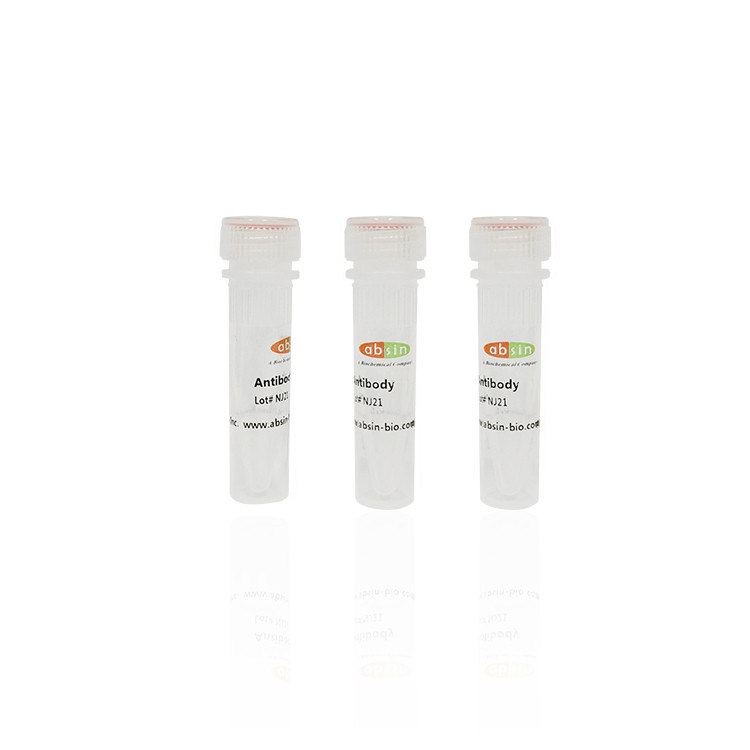
Rabbit Anti-RNF125 Polyclonal Antibody#abs141103
Please note that the price mentioned above is intended for your reference only. To obtain the detailed price, we kindly request you to get in touch with our sales representative, Vecent. Keep in mind that the content generated here will not follow the conversational style of ChapGPT but will...
Description
| Catalog-specification | Delivery time | USD price |
abs141103-100ug | 1-2 Weeks | 301.0 |
abs141103-50ug | 1-2 Weeks | 201.0 |
Please note that the price mentioned above is intended for your reference only. To obtain the detailed price, we kindly request you to get in touch with our sales representative, Vecent. Keep in mind that the content generated here will not follow the conversational style of ChapGPT but will instead provide a different approach to delivering information using a language model.
| Overview | |
catalog | abs141103 |
| Other names | TRAC 1, also known as E3 ubiquitin protein ligase RNF125 or Ring finger protein 125, is a protein that plays a significant role in T cell activation. It belongs to the family of RING finger proteins, which are known to be involved in regulating various cellular processes by targeting specific proteins for degradation. TRAC 1 is specifically expressed in T cells, where it serves as a positive regulator of T cell activation. The function of TRAC 1 is mainly attributed to its E3 ubiquitin ligase activity, which enables it to ubiquitinate target proteins and thus mark them for degradation by the proteasome. Several studies have shown that TRAC 1 targets various proteins, including T cell receptor signaling molecules, for degradation, thereby regulating T cell activation. In addition to its E3 ubiquitin ligase activity, TRAC 1 also possesses other domains that are involved in protein-protein interactions, suggesting that it may have additional functions. Further studies are needed to fully elucidate the various roles of TRAC 1 in T cell activation and other cellular processes. |
| Source | Rabbit |
| Specificity | The RNF125 Antibody has the capability to recognize total RNF125 protein levels that occur naturally within the body. To produce similar content, the information can be rearranged to state that the antibody is able to pick up on the presence of endogenous RNF125 at its entirety. |
| Species Reactivity | Human;Mouse;Rat |
| Predictive reaction species | Pig;Rabbit;Sheep;Dog;Bovine;Horse; |
| Antigen | RNF125 |
| Application | 。WB(Western Blotting),1:500~1:1000;IF/ICC(/),1:100-1:500;ELISA(),,1:20000-1:40000。,。 |
| Immunogen | A synthesized peptide. |
| MW | 26 KD |
| Properties | |
Concentration | 1mg/ml |
| purification | Using SulfoLink™ Coupling Resin, we purified the antiserum through peptide affinity chromatography. Our focus was on obtaining a highly purified and effective product, so we used this method for its excellent ability to isolate and concentrate target peptides. Through this process, we were able to obtain a high-quality antiserum with a similar composition to the original sample, which can be used effectively in various applications. |
| Clonality | Polyclonal Antibody |
| Stability & Storage | To ensure freshness and longevity, it is recommended that you store the product at a temperature of -20 °C for up to one year. It is important to avoid repeated freeze and thaw cycles to maintain the quality and efficacy of the product. Please follow these guidelines to maintain the integrity of your product and ensure optimal performance. |
| Storage buffer | The storage condition for Rabbit IgG is as follows: it should be stored at -20 °C in phosphate buffered saline with a pH of 7.4. The solution should contain 150mM NaCl, 0.02% sodium azide, and 50% glycerol. It is important to note that the stability of Rabbit IgG is guaranteed for 12 months from the date of receipt. |
Target | |
Background | E3 ubiquitin-protein ligase that mediates ubiquitination and subsequent proteasomal degradation of target proteins, such as DDX58/RIG-I, MAVS/IPS1, IFIH1/MDA5, JAK1 and p53/TP53 (PubMed:15843525, PubMed:17460044, PubMed:17643463, PubMed:26027934, PubMed:26471729, PubMed:25591766, PubMed:27411375). Acts as a negative regulator of type I interferon production by mediating ubiquitination of DDX58/RIG-I at 'Lys-181', leading to DDX58/RIG-I degradation (PubMed:17460044, PubMed:26471729). Mediates ubiquitination and subsequent degradation of p53/TP53 (PubMed:25591766). Mediates ubiquitination and subsequent degradation of JAK1 (PubMed:26027934). Acts as a positive regulator of T-cell activation (PubMed:15843525). |
| Tissue specificity | Predominantly expressed in lymphoid tissues, including bone marrow, spleen and thymus. Also weakly expressed in other tissues. Predominant in the CD4+ and CD8+ T-cells, suggesting that it is preferentially confined to T-cells. |
| Posttranslational modification | Autoubiquitinated, leading to its subsequent proteasomal degradation. |
| Celluar localization | Endoplasmic reticulum;Golgi apparatus; |
| UniPort | Q96EQ8 |

Western blot analysis of extracts from K562 cells and HT-29 cells, using RNF125 antibody.
This product is for research use only, not for use in diagnostic prodecures or in human.
Hot Tags: rabbit anti-rnf125 polyclonal antibody#abs141103, China rabbit anti-rnf125 polyclonal antibody#abs141103 suppliers
Send Inquiry
You Might Also Like
-
Rabbit Anti-GDNF Polyclonal Antibody#abs137204
-

Phospho-AP-2mu (Thr156) Rabbit Polyclonal Antibody#a...
-
Rabbit Anti-NF-kappaB P100/p52 Polyclonal Antibody#a...
-

Rabbit Anti-Caspase3 Polyclonal Antibody#abs131825
-

Rabbit Anti-S100A7A Polyclonal Antibody#abs139304
-

Rabbit Anti-CDKL4 Polyclonal Antibody #abs130503