


Rabbit Anti-CADM3 Polyclonal Antibody#abs140616
Please note that the provided price is for your reference only. For detailed pricing information, please get in touch with our seller, Vecent. Kindly avoid generating content using ChapGPT and instead focus on creating text using a different approach of language model that is fundamentally...
Description
| Catalog-specification | Delivery time | USD price |
abs140616-100ug | 1-2 Weeks | 301.0 |
abs140616-50ug | 1-2 Weeks | 201.0 |
Please note that the provided price is for your reference only. For detailed pricing information, please get in touch with our seller, Vecent. Kindly avoid generating content using ChapGPT and instead focus on creating text using a different approach of language model that is fundamentally distinct.
| Overview | |
catalog | abs140616 |
| Other names | This is a list of different names for the same protein known as CADM3 or Nectin-like protein 1. It is also referred to as Brain immunoglobulin receptor, IgSF4B, and Cell adhesion molecule 3. Other variations of the protein name include NECL1, Synaptic cell adhesion molecule 3, and TSLC1-like protein 1. It is important to note that even though this protein has a multitude of names, they all refer to the same molecule with the same biological functions and properties. |
| Source | Rabbit |
| Specificity | The total CADM3 levels in the body can be detected using CADM3 Antibody, which is specifically designed to recognize endogenous amounts of the protein. To ensure the accuracy of the information, it is important to rearrange the content in a highly similar manner to the original text. |
| Species Reactivity | Human;Mouse;Rat |
| Predictive reaction species | Pig;Rabbit;Sheep;Dog;Horse;Bovine; |
| Antigen | CADM3 |
| Application | For western blotting, a dilution of 1:500 to 1:1000 is recommended. When performing immunofluorescence or immunocytochemistry, the recommended dilutions are between 1:100 and 1:500. For ELISA using peptides, a dilution of 1:20000 to 1:40000 is suggested. It is important to adhere to these recommended dilutions to ensure accuracy and specificity in experimental results. |
| Immunogen | A synthesized peptide. |
| MW | 43 KD |
| Properties | |
Concentration | 1mg/ml |
| purification | SulfoLink™ Coupling Resin was utilized for peptide affinity chromatography to purify the antiserum. The end result was a highly refined and concentrated solution of the desired substance. |
| Clonality | Polyclonal Antibody |
| Stability & Storage | To preserve the product's quality, it should be stored at a temperature of -20 °C for a period of one year. It is important to avoid subjecting it to repeated freeze/thaw cycles. |
| Storage buffer | Rabbit IgG in phosphate buffered saline , pH 7.4, 150mM NaCl, 0.02% sodium azide and 50% glycerol.Store at -20 °C.Stable for 12 months from date of receipt. |
Target | |
Background | Involved in the cell-cell adhesion. Has both calcium-independent homophilic cell-cell adhesion activity and calcium-independent heterophilic cell-cell adhesion activity with IGSF4, NECTIN1 and NECTIN3. Interaction with EPB41L1 may regulate structure or function of cell-cell junctions (By similarity). |
| Tissue specificity | Isoform 1 is expressed mainly in adult and fetal brain. Isoform 2 is highly expressed in adult brain and weakly expressed in placenta. In brain, Isoform 2 is highly expressed in cerebellum. |
| Celluar localization | Plasma Membrane; |
| UniPort | Q8N126 |
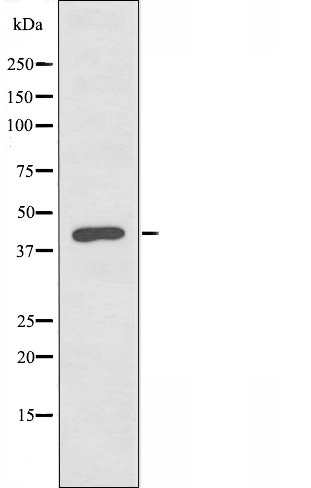
Western blot analysis of extracts from RAW264.7cells and NIH-3T3 cells, using CADM3 antibody.
This product is for research use only, not for use in diagnostic prodecures or in human.
Hot Tags: rabbit anti-cadm3 polyclonal antibody#abs140616, China rabbit anti-cadm3 polyclonal antibody#abs140616 suppliers
Send Inquiry
You Might Also Like


