


Rabbit Anti-Acetyl-NF-kappaB P65 (Lys310) Polyclonal Antibody#abs130615
Please be advised that the price listed is for reference only and to obtain detailed pricing information, kindly reach out to our seller, Vecent. It is important to note that any content generated should be highly similar but arranged in a new and unique way, based on the original text...
Description
Catalog-specification | Delivery time | USD price |
abs130615-50ug | 1-2 Weeks | 201 |
abs130615-100ug | 1-2 Weeks | 301 |
Please be advised that the price listed is for reference only and to obtain detailed pricing information, kindly reach out to our seller, Vecent. It is important to note that any content generated should be highly similar but arranged in a new and unique way, based on the original text information provided. Please refrain from using ChapGPT to generate content and instead use a language model to create a completely distinct message.
Overview | |
Description | NF-kappa-B is a versatile transcription factor that exists in virtually all cells and contributes to a range of biological functions, including inflammation, immunity, cell differentiation, growth, programmed cell death, and tumor formation. Its activity can be modulated by a variety of stimuli, making it a key player in the cellular response to internal and external stressors. Overall, NF-kappa-B is a critical regulator of many biological processes and provides a molecular mechanism for cells to rapidly and coordinately respond to changing environmental conditions. |
Other names | The Avian reticuloendotheliosis viral (v rel) oncogene homolog A, also known as NFKB3 or p65, is a transcription factor that plays a critical role in the regulation of immune responses and inflammation. This protein is encoded by the NF-kappa-B p65 subunit gene, which is expressed in various cells and tissues throughout the body. |
Source | Rabbit |
Specificity | The Antibody for Acetyl-NF-kappaB p65 (Lys310) specifically identifies the acetylated form of NF-kappaB p65 protein at lysine310. It is capable of detecting the endogenous levels of total NF-kappaB p65 protein only under these conditions. To summarize, this antibody is designed to recognize and measure the presence of acetylated NF-kappaB p65 protein at lysine310. |
| Reactivity | Human;Mouse;Rat |
| Antigen | Acetyl-NF-kappaB p65 |
Application | For WB, the recommended dilution range is 1:500 to 1:2000, while for IHC, the dilution range is recommended to be 1:50 to 1:200. The recommended dilution for IF is 1:200, and for ELISA (peptide), the recommended dilution range is 1:20,000 to 1:40,000. It is important to note that these dilution ranges are based on the original text information and should be followed carefully for optimal results. |
Immunogen | The production of antiserum involved synthesizing a peptide from human NF-kappaB p65 that was derived from the acetylated site of Lys310. This allowed for the generation of a highly specific and targeted antiserum that can effectively recognize and bind to the protein. The use of synthesized peptides in the production of antiserum ensures greater accuracy and precision, as it allows for the manipulation of specific sites and epitopes. This approach is commonly used in the development of antiserum for various applications, including diagnostics, therapeutics, and research. Overall, the production of this antiserum was a well-controlled and precise process that resulted in a highly effective product. |
Properties | |
| MW | 65 KD |
Concentration | 1mg/ml |
Purification | affinity purification. |
Clonality | Polyclonal Antibody |
Stability & Storage | To maintain the quality of the product, it is recommended to store it at a temperature of -20°C for a period of one year. It is important to avoid subjecting the product to repeated freeze/thaw cycles, as this can compromise its efficacy and potency. Taking care to store the product properly will help to ensure that it remains effective and reliable when needed. |
Storage buffer | Rabbit IgG in phosphate buffered saline , pH 7.4, 150mM NaCl, 0.02% sodium azide. |
Target | |
Background | NF-kappa-B is a pleiotropic transcription factor present in almost all cell types and is the endpoint of a series of signal transduction events that are initiated by a vast array of stimuli related to many biological processes such as inflammation, immunity, differentiation, cell growth, tumorigenesis and apoptosis. NF-kappa-B is a homo- or heterodimeric complex formed by the Rel-like domain-containing proteins RELA/p65, RELB, NFKB1/p105, NFKB1/p50, REL and NFKB2/p52 and the heterodimeric p65-p50 complex appears to be most abundant one. The dimers bind at kappa-B sites in the DNA of their target genes and the individual dimers have distinct preferences for different kappa-B sites that they can bind with distinguishable affinity and specificity. Different dimer combinations act as transcriptional activators or repressors, respectively. NF-kappa-B is controlled by various mechanisms of post-translational modification and subcellular compartmentalization as well as by interactions with other cofactors or corepressors. NF-kappa-B complexes are held in the cytoplasm in an inactive state complexed with members of the NF-kappa-B inhibitor (I-kappa-B) family. In a conventional activation pathway, I-kappa-B is phosphorylated by I-kappa-B kinases (IKKs) in response to different activators, subsequently degraded thus liberating the active NF-kappa-B complex which translocates to the nucleus. NF-kappa-B heterodimeric p65-p50 and p65-c-Rel complexes are transcriptional activators. The NF-kappa-B p65-p65 complex appears to be involved in invasin-mediated activation of IL-8 expression. The inhibitory effect of I-kappa-B upon NF-kappa-B the cytoplasm is exerted primarily through the interaction with p65. p65 shows a weak DNA-binding site which could contribute directly to DNA binding in the NF-kappa-B complex. Associates with chromatin at the NF-kappa-B promoter region via association with DDX1. Essential for cytokine gene expression in T-cells (PubMed:15790681). |
| Posttranslational modification | Ubiquitinated, leading to its proteasomal degradation. Degradation is required for termination of NF-kappa-B response.Monomethylated at Lys-310 by SETD6. Monomethylation at Lys-310 is recognized by the ANK repeats of EHMT1 and promotes the formation of repressed chromatin at target genes, leading to down-regulation of NF-kappa-B transcription factor activity. Phosphorylation at Ser-311 disrupts the interaction with EHMT1 without preventing monomethylation at Lys-310 and relieves the repression of target genes (By similarity).Phosphorylation at Ser-311 disrupts the interaction with EHMT1 and promotes transcription factor activity (By similarity). Phosphorylation on Ser-536 stimulates acetylation on Lys-310 and interaction with CBP; the phosphorylated and acetylated forms show enhanced transcriptional activity. Phosphorylation at Ser-276 by RPS6KA4 and RPS6KA5 promotes its transactivation and transcriptional activities.Reversibly acetylated; the acetylation seems to be mediated by CBP, the deacetylation by HDAC3 and SIRT2. Acetylation at Lys-122 enhances DNA binding and impairs association with NFKBIA. Acetylation at Lys-310 is required for full transcriptional activity in the absence of effects on DNA binding and NFKBIA association. Acetylation at Lys-310 promotes interaction with BRD4. Acetylation can also lower DNA-binding and results in nuclear export. Interaction with BRMS1 promotes deacetylation of Lys-310. Lys-310 is deacetylated by SIRT2.S-nitrosylation of Cys-38 inactivates the enzyme activity.Sulfhydration at Cys-38 mediates the anti-apoptotic activity by promoting the interaction with RPS3 and activating the transcription factor activity.Sumoylation by PIAS3 negatively regulates DNA-bound activated NF-kappa-B.Proteolytically cleaved within a conserved N-terminus region required for base-specific contact with DNA in a CPEN1-mediated manner, and hence inhibits NF-kappa-B transcriptional activity (PubMed:18212740). |
Celluar localization | Cytosol;Nucleus; |
UniPort | Q04206 |
Data Examples
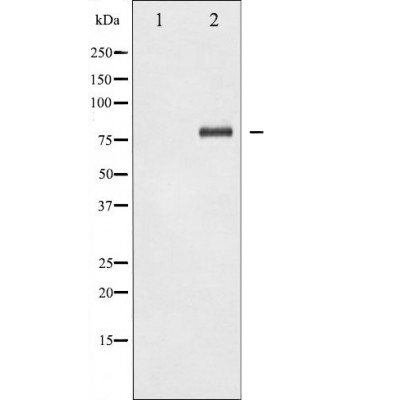
Western blot analysis of extracts from HeLa cells, treated with TSA 40nM 24h, using Acetyl-NF-kappaB p65 (Lys310) Antibody. The lane on the left is treated with the synthesized peptide.
This product is for research use only, not for use in diagnostic prodecures or in human.
Hot Tags: rabbit anti-acetyl-nf-kappab p65 (lys310) polyclonal antibody#abs130615, China rabbit anti-acetyl-nf-kappab p65 (lys310) polyclonal antibody#abs130615 suppliers
Send Inquiry
You Might Also Like


