


Rabbit Anti-LCAT Polyclonal Antibody#abs137644
Please note that the price mentioned above is only for your reference. For detailed pricing information, we kindly ask you to get in touch with our seller Vecent. Please refrain from using ChapGPT to generate content and instead focus on creating speech in a completely different manner using the...
Description
| Catalog-specification | Delivery time | USD price |
abs137644-100ug | 1-2 Weeks | 301.0 |
abs137644-50ug | 1-2 Weeks | 201.0 |
Please note that the price mentioned above is only for your reference. For detailed pricing information, we kindly ask you to get in touch with our seller Vecent. Please refrain from using ChapGPT to generate content and instead focus on creating speech in a completely different manner using the capabilities of the language model.
| Overview | |
catalog | abs137644 |
| Other names | LCAT is an abbreviation for the protein Lecithin-cholesterol acyltransferase, also known as LCAT_HUMAN. This enzyme plays an important role in the metabolism of cholesterol in the body. LCAT is responsible for converting phospholipids and cholesterol into a form that can be transported in the blood. This process involves the transfer of fatty acids from phospholipids to cholesterol, which creates a more stable and soluble form of cholesterol that can be transported by lipoproteins. Additionally, LCAT also helps to remove excess cholesterol from the body by converting it into cholesterol esters, which can be excreted in the bile. Overall, LCAT plays a crucial role in maintaining cholesterol homeostasis and preventing the buildup of cholesterol in the body. |
| Source | Rabbit |
| Specificity | The LCAT Antibody is capable of detecting total levels of endogenous LCAT protein. The highly specific antibody is designed to identify and bind to LCAT in samples and can be used for research purposes to study the expression and function of LCAT. By detecting variations in LCAT levels in different samples, researchers can gain insights into the role of LCAT in various physiological processes. Thus, the LCAT Antibody is a valuable tool for studying the function and importance of LCAT in the body. |
| Species Reactivity | Human;Mouse;Rat |
| Predictive reaction species | Sheep;Bovine;Dog;Horse; |
| Antigen | LCAT |
| Application | WB 1:1000-3000, ELISA(peptide) 1:20000-1:40000 |
| Immunogen | A synthesized peptide derived from human LCAT. |
| MW | 50 kDa |
| Properties | |
Concentration | 1mg/ml |
| purification | We utilized SulfoLink™ Coupling Resin for the purification of the antiserum through peptide affinity chromatography. |
| Clonality | Polyclonal Antibody |
| Stability & Storage | It is recommended to store the product at a temperature of -20 °C for a period of one year to maintain its quality. To ensure the effectiveness of the product, it is important to avoid subjecting it to repeated freeze/thaw cycles. |
| Storage buffer | The rabbit IgG is stored in a solution containing phosphate buffered saline with a pH of 7.4, 150mM NaCl, 0.02% sodium azide, and 50% glycerol. It should be stored at a temperature of -20°C. The stability of the IgG is guaranteed for 12 months from the date of receipt. |
Target | |
Background | Central enzyme in the extracellular metabolism of plasma lipoproteins. Synthesized mainly in the liver and secreted into plasma where it converts cholesterol and phosphatidylcholines (lecithins) to cholesteryl esters and lysophosphatidylcholines on the surface of high and low density lipoproteins (HDLs and LDLs) (PubMed:10329423, PubMed:19065001, PubMed:26195816). The cholesterol ester is then transported back to the liver. Has a preference for plasma 16:0-18:2 or 18:O-18:2 phosphatidylcholines (PubMed:8820107). Also produced in the brain by primary astrocytes, and esterifies free cholesterol on nascent APOE-containing lipoproteins secreted from glia and influences cerebral spinal fluid (CSF) APOE- and APOA1 levels. Together with APOE and the cholesterol transporter ABCA1, plays a key role in the maturation of glial-derived, nascent lipoproteins. Required for remodeling high-density lipoprotein particles into their spherical forms (PubMed:10722751). |
| Tissue specificity | Detected in blood plasma (PubMed:3458198, PubMed:8820107, PubMed:10222237). Detected in cerebral spinal fluid (at protein level) (PubMed:10222237). Detected in liver (PubMed:3797244, PubMed:3458198). Expressed mainly in brain, liver and testes. |
| Posttranslational modification | O- and N-glycosylated. O-glycosylation on Thr-431 and Ser-433 consists of sialylated galactose beta 1-->3N-acetylgalactosamine structures. N-glycosylated sites contain sialylated triantennary and/or biantennary complex structures. |
| Celluar localization | Extracellular region or secreted; |
| UniPort | P04180 |
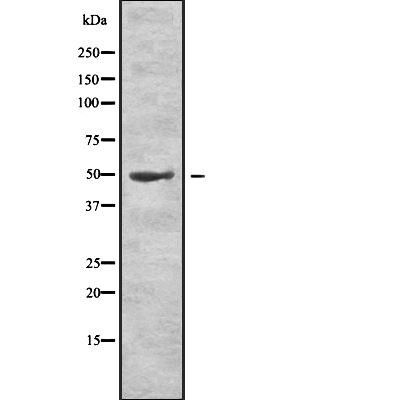
Western blot analysis LCAT using HuvEc whole cell lysates
This product is for research use only, not for use in diagnostic prodecures or in human.
Hot Tags: rabbit anti-lcat polyclonal antibody#abs137644, China rabbit anti-lcat polyclonal antibody#abs137644 suppliers
Send Inquiry
You Might Also Like
-

Rabbit Anti-ABI2 Polyclonal Antibody#abs137547
-

Phospho-PNKP (Ser114) Rabbit Polyclonal Antibody#abs...
-

Rabbit Anti-TSYL2 Polyclonal Antibody#abs132845
-

Rabbit Anti-PHOX2B Polyclonal Antibody#abs139250
-
Phospho-ERK1/2 (Thr202/Tyr204) Rabbit Polyclonal Ant...
-

Rabbit Anti-FHIT Polyclonal Antibody #abs130458