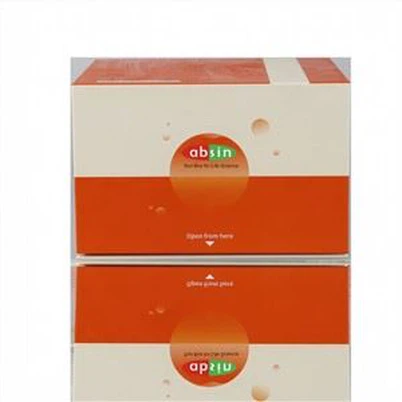
Six Color Multiplex Fluorescent Immunostaining Kit (Anti Rabbit)
Please note that the price provided is for your reference only. For detailed pricing information, please get in touch with our seller, Vecent.
Description
| SKU-Pack Size | Availability | Price |
| abs50030-20T | 1-2 weeks | $1037.00 |
| abs50030-100T | 1-2 weeks | $3785.00 |
Please note that the price provided is for your reference only. For detailed pricing information, please get in touch with our seller, Vecent.
Description | |
| Description | In the tissue microenvironment, there exists a multitude of intricate cells. The characteristics of these cells, including their state, quantity, distribution and phenotype, are crucial to both biological significance and clinical significance. It can be shown in situ by antibody staining.Immunohistochemical staining is a prevalent technique for investigating the morphology of tissues and the expression of proteins in situ. However, conventional IHC techniques only permit the detection of a single indicator, which makes it challenging to identify the composition, state, and intercellular relationships in the complex tissue microenvironment. This information is critical for the accurate diagnosis and treatment of various diseases. Therefore, advanced techniques that allow for a more comprehensive analysis of tissue microenvironments are essential in modern medicine. The tyrammonia signal amplification technology operates on a similar principle as the DAB color rendering method in traditional immunohistochemistry. Here, the technique also utilizes a secondary antibody labeled with HRP. The HRP enzyme then facilitates the addition of a fluorescepin substrate to the system, resulting in the generation of an activated fluorescent substrate. This activated substrate possesses the ability to covalently bind with tyrosine residues present on the antigen. Consequently, a stable covalent bond is formed, enabling the attachment of fluorescepin to the sample. By rearranging the given information, a similarly informative content can be generated.Following the initial step, the antibodies that were bound through non-covalent interactions underwent a hot repair process to remove them. Subsequently, a second incubation was carried out with another primary antibody and a different luciferase substrate. This step was essential to achieve multiple labeling of the target. |
| Applications | This technique finds primary application in the immunohistochemical staining of paraffin sections, TMA chips, and human or mouse tissues. |
| Usage | To dilute the fluorescent dye, you can dissolve the dry powder with 100ul of DMSO to make 100X dye mother liquor. If the dye is in liquid form, then the factory will have already dissolved it in DMSO to make the 100X mother liquor. After that, the signal amplification reaction solution needs to be diluted at a ratio of 1:100 to prepare the dye working solution. DAPI, on the other hand, should be diluted with sterile water at a ratio of 1:100 to prepare the working solution. When it comes to using the secondary antibody, the kit in question is an anti-rabbit secondary antibody, which is suitable for mouse tissue. Before starting the experiment, it's important to check whether the species of primary antibody matches the secondary antibody. If you need a reference point, you can look at the human sample (# ABS50014). Ensuring that the species of primary antibody matches the secondary antibody is crucial in order to ensure the accuracy and validity of your experimental results. |
| General Notes | 1. This kit is only used for immunohistochemistry, not for other purposes. 2. This kit is for professional use only. 3. Appropriate protective measures should be taken to avoid contact with skin and eyes. 4. Do not use reagents that are past their expiry date because their activity may be reduced. 5. If the staining components of this kit are mixed with the products of other companies, abnormal conditions may occur during the dyeing process. 6 dewaxing is not complete, easy to affect the dyeing effect. 7. In order to prevent possible false negative and false positive results, it is necessary to have both positive and negative controls during the experiment. 8. All waste generated from the use of this kit should be treated in accordance with the Regulations on the Management of Medical Waste. |
Overview | |
| Storage Temp. | Fluorescent dye should be stored away from light, 2 ~ 8℃ storage, receipt of goods is valid for 12 months. |
References | |
| References | Diagnostic Immunohistochemistry (M). Beijing: Peking University Medical Press, 2008.9.2.【America】Ed Harlow, David Lane. Technical Guide for antibody (M). Beijing: Science Press, 2002:79-80,105.3.Stack, E. C., et al., vesicular ANATOMY and vesicular anatomy; imaging and quantitation: a review, with an assessment of Tyramide signal amplification, multispectral imaging and multiplex analysis. Methods, 2014, 70 (1) : 46-58.4. Qian Bangguo. Jiao Lei. Application of multilabel immunofluorescence staining and Doppler imaging in histological study. Chinese Journal of Histochemistry and Cytochemistry, 2017 (4): 373-382. |
Hot Tags: six color multiplex fluorescent immunostaining kit (anti rabbit), China six color multiplex fluorescent immunostaining kit (anti rabbit) suppliers
Send Inquiry
You Might Also Like