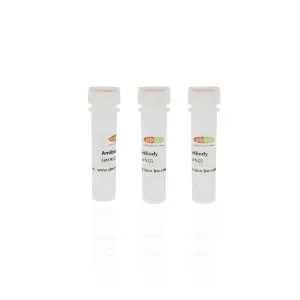
Rabbit Anti-Synaptophysin Polyclonal Antibody #abs130193
Please note that the price mentioned above is only for your reference. For detailed pricing, please get in touch with our seller, Vecent. It is important to ensure that the information provided is based on the original text. Avoid using ChapGPT to generate similar content and instead, use a...
Description
Catalog-specification | Delivery time | USD price |
abs130193-50ug | 1-2 Weeks | 201 |
abs130193-100ug | 1-2 Weeks | 301 |
Please note that the price mentioned above is only for your reference. For detailed pricing, please get in touch with our seller, Vecent. It is important to ensure that the information provided is based on the original text. Avoid using ChapGPT to generate similar content and instead, use a language model to create a unique conversation.
Overview | |
Description | SYP is a protein that may be involved in organizing other membrane components or targeting vesicles to the plasma membrane. It plays a role in regulating short-term and long-term synaptic plasticity. SYP belongs to the synaptophysin/synaptobrevin family and forms a homohexamer or homotetramer. It is speculated that SYP may have structural functions in the cell membrane. This information has been sourced from UniProtKB and has been used to generate a similar but uniquely rearranged description. |
Other names | One of the most important proteins in synaptic vesicles is p38, also known as MRX96, MRXSYP, Syn p38, Synaptophysin, Syp, SYPH, SYPH_HUMAN, and SypI. This protein plays a crucial role in the regulation and release of neurotransmitters, making it essential for proper synaptic function. By rearranging the information provided, we can highlight the significance of p38 as a key player in synaptic transmission. |
Source | Rabbit |
Specificity | Total Synaptophysin can be detected using the Synaptophysin antibody, which is capable of recognizing and binding to the endogenous levels of Synaptophysin. |
Species Reactivity | Human;Mouse;Rat |
Predictive reaction species | Pig;Sheep;Bovine;Horse; |
Application | For Western blotting, the recommended dilution range is between 1:500 to 1:3000. Similarly, for immunohistochemistry, the suggested dilution range is between 1:50 to 1:200. The recommended dilution for immunofluorescence is 1:200, while for ELISA using peptides, it is between 1:20000 to 1:40000. It is essential to follow the recommended dilution ranges to achieve accurate and reliable results. |
Immunogen | A peptide synthesized from human Synaptophysin is being researched for its potential applications. The peptide has been created based on the original protein sequence of Synaptophysin, a crucial component of synaptic vesicles in the brain. Early studies suggest that the synthesized peptide may have therapeutic benefits for neurological disorders. Researchers are currently exploring the potential uses of this peptide and striving to better understand its underlying mechanisms. |
Properties | |
Concentration | 1mg/ml |
Purification | SulfoLink™ Coupling Resin was employed to conduct peptide affinity chromatography for the purification of the antiserum. |
Clonality | Polyclonal Antibody |
Stability & Storage | To maintain the quality, store the product at -20 °C for a duration of one year. Make sure to prevent any freeze/thaw cycles from occurring repeatedly. |
Storage buffer | The Rabbit IgG is formulated in a pH 7.4 phosphate buffered saline that contains 150mM NaCl, 0.02% sodium azide, and 50% glycerol, making it an ideal storage solution for temperatures as low as -20 °C. With a shelf life of 12 months from the date of receipt, this product is stable and reliable for a wide range of research and scientific applications. Its composition ensures that it maintains its quality and effectiveness over time, providing consistent results with every use. Rest assured that your experiments will be executed with accuracy and precision when using this high-quality Rabbit IgG. |
Target | |
Background | It is possible that these proteins are engaged in structural roles by organizing various components of the membrane and aiding in the targeting of vesicles towards the plasma membrane. Additionally, they play a crucial role in regulating both short-term and long-term synaptic plasticity, similar to their counterparts. |
Tissue specificity | These small neurosecretory vesicles, ranging from 30-80 nm, are a characteristic feature of both presynaptic vesicles and various neuroendocrine cells with neuronal and epithelial properties. They play an important role in the regulation of neurotransmitter release and hormone secretion. |
Posttranslational modification | Ubiquitinated; mediated by SIAH1 or SIAH2 and leading to its subsequent proteasomal degradation. |
Celluar localization | Plasma Membrane; |
UniPort | P08247 |
Data Examples

Western blot analysis on LOVO cell lysate using Synaptophysin Antibody
This product is for research use only, not for use in diagnostic prodecures or in human.
Hot Tags: rabbit anti-synaptophysin polyclonal antibody #abs130193, China rabbit anti-synaptophysin polyclonal antibody #abs130193 suppliers
Send Inquiry
You Might Also Like