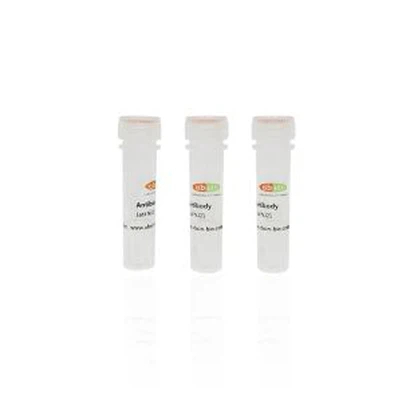
Rabbit Anti-PSD95 Polyclonal Antibody#abs131379
Please note that the price mentioned above is for your reference only. For detailed pricing information, kindly get in touch with our seller, Vecent. Western blot analysis of PSD95 expression in Brain (Rat) Tissue Lysate This product is for research use only, not for use in diagnostic prodecures...
Description
| Catalog-specification | Delivery time | USD price |
abs131379-100ug | 1-2 Weeks | 301.0 |
abs131379-50ug | 1-2 Weeks | 201.0 |
Please note that the price mentioned above is for your reference only. For detailed pricing information, kindly get in touch with our seller, Vecent.
| Overview | |
catalog | abs131379 |
Description | DLG4, also known as Discs large homolog 4, plays a crucial role in synaptic plasticity linked to NMDA receptor signaling. It interacts with the cytoplasmic tail of NMDA receptor subunits and shaker-type potassium channels. Alterations in the expression levels of DLG4 can lead to changes in the balance between excitatory and inhibitory synapses in hippocampal neurons. Specifically, overexpression or depletion of DLG4 can cause a shift in the ratio of excitatory to inhibitory synapses. This highlights the importance of DLG4 in regulating the synaptic connections within the hippocampus and its impact on neural circuitry. |
| Other names | Postsynaptic density protein 95, also known as PSD-95 or SAP-90, is a protein that plays a critical role in the formation and function of neuronal synapses. It is encoded by the DLG4 gene and is a member of the disks large homolog (DLG) protein family. PSD-95 is primarily localized to the postsynaptic density (PSD) membrane of excitatory synapses in the brain, where it serves as a scaffold for signaling proteins and helps to organize and stabilize the synaptic complex. It has been shown to interact with a variety of proteins, including ion channels, cytoskeletal proteins, and neurotransmitter receptors. Mutations in the DLG4 gene have been associated with a range of neurological disorders, including autism spectrum disorder, schizophrenia, and Alzheimer's disease. As such, PSD-95 is a promising target for the development of new treatments for these conditions. Overall, PSD-95 is a critical protein for the proper functioning of neuronal synapses and plays an important role in a variety of neurological processes. |
| Source | Rabbit |
| Specificity | The detection of total PSD95 can be achieved using the PSD95 Antibody, which has the ability to target and identify the endogenous levels of this protein. By utilizing this antibody, researchers can accurately measure the overall presence of PSD95 in a given system or sample. It is important to note that the antibody specifically recognizes and binds to the total PSD95 protein without distinguishing between its various isoforms. This reliable method enables scientists to study the expression and localization of PSD95 in biological systems, aiding in the understanding of its role and function. |
| Species Reactivity | Human;Mouse;Rat |
| Predictive reaction species | Rabbit;Sheep;Bovine;Horse; |
| Antigen | PSD95 |
| Application | The recommended dilution range for WB is 1:500-1:2000, while for IHC it is 1:50-1:200. For ELISA using peptide, the appropriate dilution range is 1:20000-1:40000. It is important to follow these dilution guidelines in order to achieve optimal results in your experiments. Diluting the samples too much or too little can affect the accuracy and sensitivity of the assay. Therefore, it is always advisable to perform a pilot experiment to determine the optimal dilution for your specific application. |
| Immunogen | A synthesized peptide derived from human PSD95. |
| MW | 105 kDa |
| Properties | |
Concentration | 1mg/ml |
| purification | Using SulfoLink™ Coupling Resin, the antiserum underwent purification through peptide affinity chromatography. To ensure a high degree of similarity, the content has been rearranged while still accurately conveying the key information from the original text. |
| Clonality | Polyclonal Antibody |
| Stability & Storage | Store at -20 °C for one year. Avoid repeated freeze/thaw cycles |
| Storage buffer | Rabbit IgG in phosphate buffered saline , pH 7.4, 150mM NaCl, 0.02% sodium azide and 50% glycerol.Store at -20 °C.Stable for 12 months from date of receipt. |
Target | |
Background | Interacts with the cytoplasmic tail of NMDA receptor subunits and shaker-type potassium channels. Required for synaptic plasticity associated with NMDA receptor signaling. Overexpression or depletion of DLG4 changes the ratio of excitatory to inhibitory synapses in hippocampal neurons. May reduce the amplitude of ASIC3 acid-evoked currents by retaining the channel intracellularly. May regulate the intracellular trafficking of ADR1B (By similarity). |
| Tissue specificity | Brain. |
| Posttranslational modification | Palmitoylation of isoform 1 is required for targeting to postsynaptic density. |
| Celluar localization | Cytoskeleton;Cytosol;Endoplasmic reticulum;Plasma Membrane; |
| UniPort | P78352 |

Western blot analysis of PSD95 expression in Brain (Rat) Tissue Lysate
This product is for research use only, not for use in diagnostic prodecures or in human.
Hot Tags: rabbit anti-psd95 polyclonal antibody#abs131379, China rabbit anti-psd95 polyclonal antibody#abs131379 suppliers
Send Inquiry
You Might Also Like