


Rabbit Anti-PRKAG1/2/3 Polyclonal Antibody#abs133516
Please note that the price mentioned above is only for your reference. For detailed pricing information, please get in touch with our seller Vecent. Kindly refrain from using ChapGPT to generate content in the same manner, but rather utilize a language model to generate text with a completely...
Description
| Catalog-specification | Delivery time | USD price |
abs133516-100ug | 1-2 Weeks | 301.0 |
abs133516-50ug | 1-2 Weeks | 201.0 |
Please note that the price mentioned above is only for your reference. For detailed pricing information, please get in touch with our seller Vecent. Kindly refrain from using ChapGPT to generate content in the same manner, but rather utilize a language model to generate text with a completely different approach to communication.
| Overview | |
catalog | abs133516 |
| Other names | The 5' AMP activated protein kinase subunit gamma-1, also known as AAKG1_HUMAN or AMPK gamma 1 chain, is a non-catalytic subunit of the AMP-activated protein kinase. It plays a crucial role in regulating cellular energy homeostasis by sensing and responding to changes in the AMP/ATP ratio. Other aliases for this protein include PRKAG1, CMH6, and MGC8666. Similarly, the 5' AMP-activated protein kinase subunit gamma-2, also called AAKG2_HUMAN or AMPK gamma 2, is a non-catalytic subunit of the AMP-activated protein kinase. It is involved in regulating energy metabolism and may play a role in cardiac function and glucose metabolism. Additional names for this protein include PRKAG2, WPWS, and H91620p. Finally, the 5' AMP-activated protein kinase subunit gamma-3, also known as AAKG3_HUMAN or AMPK gamma 3 chain, is a non-catalytic subunit of the AMP-activated protein kinase that is involved in regulating energy metabolism and glucose uptake. Other names for this protein include PRKAG3 and AMPKG3. Overall, these subunits are critical components of the AMP-activated protein kinase complex, which acts as a cellular energy sensor and regulator. By modulating cellular energy pathways, these subunits play important roles in a diverse range of physiological processes and have been implicated in the pathophysiology of many diseases. |
| Source | Rabbit |
| Specificity | Our PRKAG1/2/3 Antibody is specifically designed to detect the total PRKAG1/2/3 protein levels present in the natural state. By rearranging the content of the original text, we can provide a similar description with a slightly different presentation. |
| Species Reactivity | Human;Mouse;Rat |
| Predictive reaction species | Chicken;Rabbit;Pig;Dog;Bovine;Sheep; |
| Antigen | PRKAG1/2/3 |
| Application | For Western Blotting, the recommended dilution range is between 1:500 to 1:1000, while for Immunofluorescence/Immunocytochemistry, the range is between 1:100 to 1:500. For ELISA tests that use peptides, the recommended dilution range is between 1:20000 to 1:40000. These dilution ranges are crucial in ensuring that accurate and reliable results are obtained in various laboratory tests and experiments. It is important to follow the recommended dilution ranges to avoid erroneous and inconsistent results that could negatively impact research outcomes. |
| Immunogen | A synthesized peptide. |
| MW | 38 KD |
| Properties | |
Concentration | 1mg/ml |
| purification | The antiserum was purified by peptide affinity chromatography using SulfoLink™ Coupling Resin . |
| Clonality | Polyclonal Antibody |
| Stability & Storage | Store at -20 °C for one year. Avoid repeated freeze/thaw cycles |
| Storage buffer | Rabbit IgG in phosphate buffered saline , pH 7.4, 150mM NaCl, 0.02% sodium azide and 50% glycerol.Store at -20 °C.Stable for 12 months from date of receipt. |
Target | |
Background | AMP/ATP-binding subunit of AMP-activated protein kinase (AMPK), an energy sensor protein kinase that plays a key role in regulating cellular energy metabolism. In response to reduction of intracellular ATP levels, AMPK activates energy-producing pathways and inhibits energy-consuming processes: inhibits protein, carbohydrate and lipid biosynthesis, as well as cell growth and proliferation. AMPK acts via direct phosphorylation of metabolic enzymes, and by longer-term effects via phosphorylation of transcription regulators. Also acts as a regulator of cellular polarity by remodeling the actin cytoskeleton; probably by indirectly activating myosin. Gamma non-catalytic subunit mediates binding to AMP, ADP and ATP, leading to activate or inhibit AMPK: AMP-binding results in allosteric activation of alpha catalytic subunit (PRKAA1 or PRKAA2) both by inducing phosphorylation and preventing dephosphorylation of catalytic subunits. ADP also stimulates phosphorylation, without stimulating already phosphorylated catalytic subunit. ATP promotes dephosphorylation of catalytic subunit, rendering the AMPK enzyme inactive. |
| Posttranslational modification | Phosphorylated by ULK1 and ULK2; leading to negatively regulate AMPK activity and suggesting the existence of a regulatory feedback loop between ULK1, ULK2 and AMPK. |
| Celluar localization | Cytosol;Extracellular region or secreted;Nucleus; |
| UniPort | P54619/Q9UGJ0/Q9UGI9 |
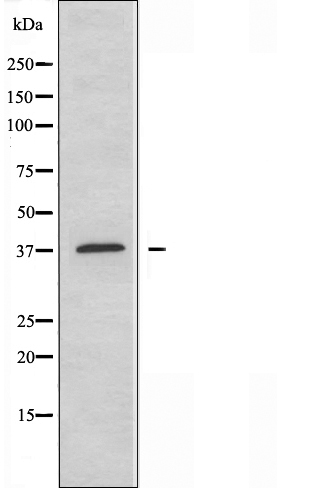
Western blot analysis of extracts from Jurkat cells and 293 cells, using PRKAG1/2/3 antibody.
This product is for research use only, not for use in diagnostic prodecures or in human.
Hot Tags: rabbit anti-prkag1/2/3 polyclonal antibody#abs133516, China rabbit anti-prkag1/2/3 polyclonal antibody#abs133516 suppliers
Send Inquiry
You Might Also Like
-

Rabbit Anti-Smurf Polyclonal Antibody#abs137190
-

Rabbit Anti-RASA2 Polyclonal Antibody#abs133026
-

Rabbit Anti-BDKRB1 Polyclonal Antibody#abs139719
-

Rabbit Anti-Ring1A Polyclonal Antibody#abs131143
-

Phospho-TK (Ser13) Rabbit Polyclonal Antibody#abs130696
-

Phospho-AKT1(Thr308) Rabbit Polyclonal Antibody #abs...