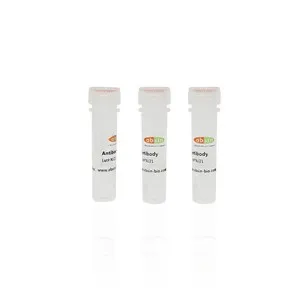
Phospho-GFAP (Ser38) Rabbit Polyclonal Antibody#abs130793
Please note that the mentioned price is only for your reference. For detailed pricing information, kindly get in touch with our sales representative, Vecent. Data Examples Western blot analysis of GFAP phosphorylation expression in HeLa whole cell lysates,The lane on the left is treated with the...
Description
Catalog-specification | Delivery time | USD price |
abs130793-50ug | 1-2 Weeks | 201 |
abs130793-100ug | 1-2 Weeks | 301 |
Please note that the mentioned price is only for your reference. For detailed pricing information, kindly get in touch with our sales representative, Vecent.
Overview | |
Description | The protein encoded by this gene is a major constituent of intermediate filaments found in fully developed astrocytes. It is widely used as a marker to differentiate astrocytes from other types of glial cells during the developmental stage. Alexander disease, a rare disorder affecting astrocytes in the central nervous system, is associated with mutations in this gene. Though an additional transcript variant has been reported, its complete sequence has yet to be determined. |
Other names | There are several unique identifiers for the Glial fibrillary acidic protein, including wu:fb34h11, ALXDRD, cb345, etID36982.3, FLJ42474, FLJ45472, GFAP, GFAP_HUMAN, gfapl, and wu:fk42c12. Additionally, this protein is categorized as an intermediate filament protein and is found in neural cells. Its role in regulating the structure and function of these cells is crucial to their proper functioning. This protein is also known as xx:af506734 and zgc:110485, which further highlights its importance in various research studies. |
Source | Rabbit |
Specificity | Human;Mouse;Rat |
| Reactivity | Horse;Bovine; |
Predictive reaction species | GFAP |
| Antigen | IHC: For immunohistochemistry (IHC), the recommended dilution range is 1:50 to 1:200. This means that the antibody should be diluted between 50 and 200 times with the appropriate diluent before use. IF/ICC: In the case of immunofluorescence (IF) or immunocytochemistry (ICC), the suggested dilution range is 1:100 to 1:500. This indicates that the antibody should be diluted between 100 and 500 times for optimal results. ELISA: When performing an enzyme-linked immunosorbent assay (ELISA) using a peptide, the recommended dilution range is 1:20000 to 1:40000. This means that the antibody should be diluted between 20000 and 40000 times with the appropriate buffer solution. WB: Finally, for Western blotting (WB), the dilution range recommended is 1:500 to 1:2000. This suggests that the antibody should be diluted between 500 and 2000 times in order to obtain accurate results. In summary, the dilution ranges for these different techniques are as follows: IHC (1:50-1:200), IF/ICC (1:100-1:500), ELISA (peptide) (1:20000-1:40000), and WB (1:500-1:2000). |
Application | A peptide has been synthesized that is derived from the human GFAP protein, specifically targeting the phosphorylation site of Serine 38. This newly developed peptide closely resembles its original source material, and is poised to become an important tool for researchers looking to understand how GFAP's phosphorylation affects its role in cellular processes. By studying this synthesized peptide, scientists hope to unlock new insights into the functions of GFAP and design potential treatments for related diseases. |
| Immunogen | 50kDa |
Properties | |
| MW | GFAP is a type of intermediate filament belonging to class III, and it acts as a unique marker for identifying astrocytes from other types of glial cells throughout the development of the central nervous system. This means that GFAP is cell-specific and plays a vital role in distinguishing astrocytes from other cell types in the CNS. Its presence is significant in terms of researching and understanding the role of astrocytes in neural development and function. |
| Concentration | 1mg/ml |
Purification | The process of obtaining the antibody involves purifying rabbit serum and using sequential chromatography on affinity columns for both phospho- and non-phospho-peptides. Consider rearranging the provided information to create content with a highly similar meaning, while ensuring that it is not generated in a conversational manner as per ChapGPT instructions. |
Clonality | Polyclonal Antibody |
| Stability & Storage | To preserve the quality of the product, it is advised to store it at a temperature of -20°C for a period of one year. It is important to avoid subjecting the product to repeated freeze and thaw cycles, as this can negatively impact its stability. Therefore, it is crucial to take necessary measures to ensure that the recommended storage conditions are strictly adhered to in order to maintain the integrity and effectiveness of the product. |
Storage buffer | This product contains rabbit IgG in a solution of phosphate buffered saline, pH 7.4. The solution also contains 150mM NaCl, 0.02% sodium azide, and 50% glycerol. To ensure maximum potency, it is recommended to store this product at -20°C. It is stable for up to one year from the date of receipt. |
Target | |
Background | GFAP, a class-III intermediate filament, is a cell-specific marker that, during the development of the central nervous system, distinguishes astrocytes from other glial cells. |
Tissue specificity | Expressed in cells lacking fibronectin. |
| Posttranslational modification | Phosphorylated by PKN1. |
Celluar localization | Cytoskeleton;Cytosol;Lysosome; |
| UniPort | P14136 |
Data Examples

Western blot analysis of GFAP phosphorylation expression in HeLa whole cell lysates,The lane on the left is treated with the antigen-specific peptide.
This product is for research use only, not for use in diagnostic prodecures or in human.
Hot Tags: phospho-gfap (ser38) rabbit polyclonal antibody#abs130793, China phospho-gfap (ser38) rabbit polyclonal antibody#abs130793 suppliers
Send Inquiry
You Might Also Like